
The Nationals' Fight for Food Security proceeds to the Senate - Joint Media Release

Dr Anne Webster MP
Shadow Minister for Regional Communications
Shadow Minister for Regional Development, Local Government and Territories
Federal Member for Mallee
Matt Canavan
Senator for Queensland
The Nationals are today taking another major step toward preserving Australia’s food security with the tabling of proposed laws to ban federal funding of projects that diminish prime agricultural land, or place it under foreign ownership.
In the Senate today, Queensland Senator Matt Canavan is today introducing The Nationals’ Prime Agricultural Land Protection Bill 2026, following the tabling of an identical Bill in the House of Representatives last week by the NSW Nationals’ Member for Lyne, Alison Penfold MP.
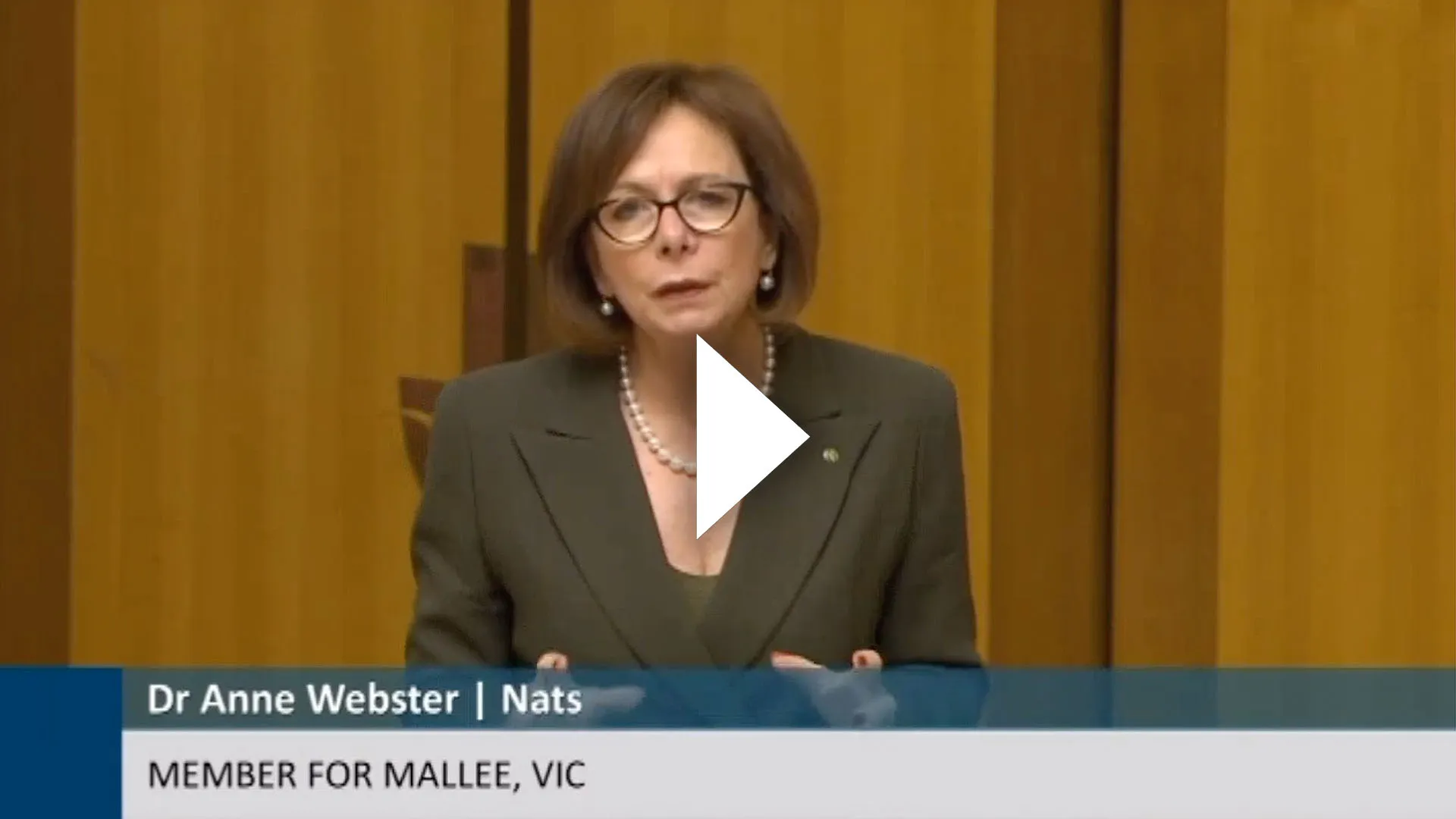
The Bill was authored by Shadow Minister for Regional Development, Local Government, Territories and Regional Communications Dr Anne Webster MP following outcry about the rapid rollout of mining and energy projects on prime agricultural land in her northwestern Victorian electorate of Mallee.
Former Resources Minister Canavan said The Nationals’ Bill drew a line in the sand after threats by often foreign-owned energy projects under Labor’s reckless all-renewables energy agenda.
“The Nationals in federal government will not support mining or energy projects that diminish Australia’s food security on our prime agricultural land. Transmission lines, wind turbines, solar farms, battery installations or critical minerals mines are unlikely to proceed at all, as they often depend on Commonwealth funding support.
“Take, for instance, renewable energy projects that rely on federal funding mechanisms like the Capacity Investment Scheme and Clean Energy Finance Corporation.”
The Nationals will map all of Australia and designate prime agricultural land, other agricultural land, and marginal land (unviable) land, and then ban Commonwealth funding for any mining or energy project:
• that reduces the productivity of Prime Agricultural Land (designated as Tier 1) – for instance by transmission lines or mining,
• that reduces any other agricultural land (Tier 2) to lesser productivity than before the project began,
• that has not properly secured Social Licence from the local community, on Tier 1 and 2 land,
Dr Webster said terrible experiences of poor rehabilitation and state government powers to compel projects to proceed threatened to kick Mallee farmers out of their homes.
“The Prime Agricultural Land Bill 2026 will ensure no Commonwealth Government leaves farmers worse off – for example, if a government-backed project cannot proceed without making a family home uninhabitable, farmers will be offered an acceptable, substitute home,” Dr Webster said.
“Our food security, our farmers and regional economies are too important to be thrown under a bus for Labor’s political targets.”
“Prime agricultural land doesn’t just happen. For generations farmers have cultivated, nurtured and preserved that soil, they’ve protected it from erosion, they have put their blood, sweat and tears into the ground that feeds and clothes our nation. When farmers are forced off their farms, when irrigation is switched off because Labor has eroded water rights, our food security is at risk.
“During the pandemic, supply chains were shaken to their core and now with a conflict in the Middle East, more supply shocks are sure to occur. Food security is national security, and The Nationals understand that and are putting it at the top of the agenda in Canberra.”
The Bill also creates a referee – the Commonwealth Agriculture Commissioner - to resolve disputes under the Act, accountable to the Agriculture Minister.