
Strengthening Enforcement for the Social Media Minimum Age
.png)
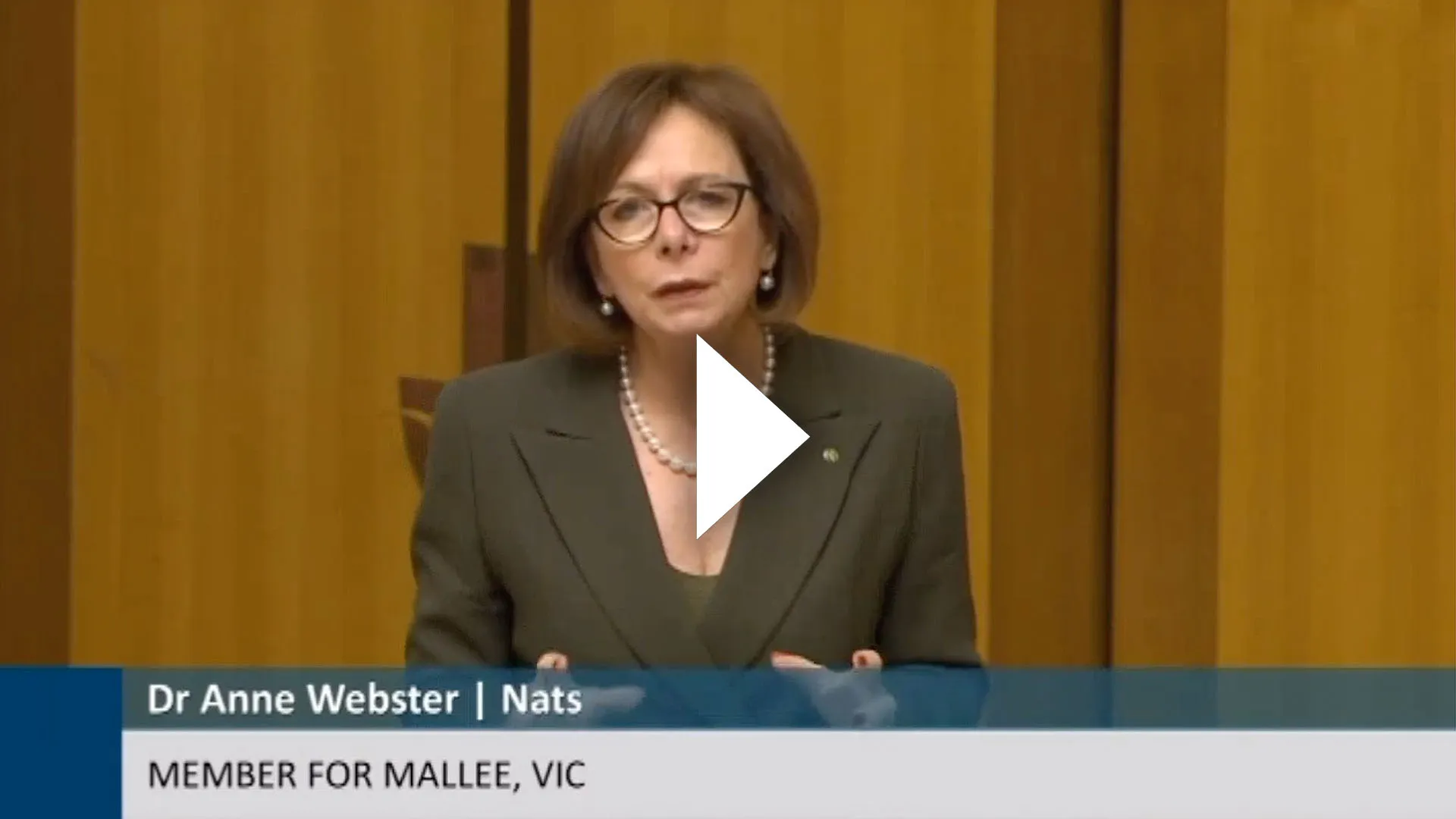
Dr WEBSTER (Mallee) (10:42): The government's first duty is to protect its citizens and, arguably, its most vulnerable citizens—in this case, children. Today that duty extends into a digital world, where the playground has actually moved online and where too often it is unpoliced and unsafe.
I recently received a deeply concerning account from a constituent in my electorate. They wrote about 15- and 11-year-old siblings from their community that have a Zoomerang account—I didn't even know there was one—and have been 'known to post or repost up to 30 videos a day'. She wrote:
After the (social media) ban was implemented, when she was 11 years old, she opened a TikTok account.
Both girls discuss issues of declining mental health, including suicidal ideation, self-harm (cutting), body dysmorphia, bullying, and, in the 15-year old's case, allegations of sexual assault.
My constituent asks that there be some sort of agency or protocol where these accounts can be collated, investigated and closed where applicable. My constituent goes on:
Concerns for the welfare of the children have been raised with the mother, a primary school, child protection, and, after a particularly concerning series of Zoomerang videos, a welfare check was requested of the police. There has been no visible or positive response from any of the places we expect to protect our children, with the younger girl telling police she is fine. This is when she stopped posting on Zoomerang and opened a TikTok account with her mother's knowledge.
This is what this government's policy failure looks like in real time.
The coalition led the way in November 2023 with our private member's bill to impose age verification online. Labor rejected it and then, in the 2024 budget, accepted it. We pledged in June 2024 that we would deliver the under-16s social media ban, which Labor, thankfully, copied.
What we know is that around five million social media accounts of children under 16 have been removed, deactivated or restricted since our world-first social media ban began. Apparently, five platforms are being investigated by the eSafety Commissioner for potential noncompliance with the ban. A University of Newcastle study, published in the British Medical Journal, found the initial age restrictions have had limited impact, finding that, among the 408 12- to 17-year-olds that were questioned three months after the ban, over 80 per cent continued to use restricted platforms and around two-thirds had encountered age-verification measures. The eSafety Commissioner's March 2026 compliance update found 70 per cent of children were still on social media. As constituents are telling us and as evidence shows, current platform safeguards and reporting mechanisms are not working as intended. Even after intervention attempts by schools, child protection and police, nothing changes. The behaviour simply moves platforms. That is not protection; that's circumvention.
The parliament agreed on the goal of protecting children online, but the current framework has not delivered. As other countries considered social media bans, Labor rushed their initiative out the door so they could claim international credit for being the first. We know that, despite the ban, large numbers of children are still accessing these platforms because enforcement has been weak and the regulator has not been given the tools it needs.
The Online Safety Amendment (Strengthening Enforcement for the Social Media Minimum Age) Bill 2026 attempts to correct what, arguably, was Labor's very poor first attempt at legislating in this area. While constituents have concerns about the reach of the eSafety Commissioner's current powers, the coalition supports regulators having more teeth, so long as those teeth are to be used on big tech. We will be vigilant and critical if these powers are misdirected at the Australian people.
We must be honest about what we're dealing with here. These are not neutral platforms. They are global businesses whose model depends on keeping users engaged at all costs. User engagement is driven by algorithms designed to maximise attention and influence behaviour. People of all ages are at risk of being influenced into negative behaviour patterns by these algorithms, but younger people are particularly vulnerable as they have not developed the critical thinking or awareness of the dangers that lurk in the dark corners of the internet. If we're not careful, we risk raising a generation conditioned for constant stimulation where deeper thinking is crowded out and attention is shaped by algorithmic incentives rather than independent judgement—or, as I like to call it, the flea brain.
I want to draw the House's attention to a judgement on 25 March in Los Angeles, where a young woman, now aged 20, initially KGM, sued Meta and YouTube, having started using YouTube at the age of six and Instagram at the age of nine. She argued that Meta intentionally engineered their platforms to be addictive, that their design caused compulsive use and that this led to depression, anxiety, body dysmorphia and suicidal thoughts. She alleged the addictive design features included infinite scrolling, autoplay videos, algorithmic recommendation feeds, push notifications and reward-style engagement. Experts in the case likened the design features to cigarettes and poker machines. A Los Angeles jury found Meta and YouTube were negligent, designed addictive products, failed to warn users and ultimately caused harm, with Mehta ordered to pay US$4.2 million and YouTube US$1.8 million. Apparently, TikTok and Snapchat settled with the same female plaintiff before trial.
There are reportedly thousands of similar cases in the US alone. Yet this government, our government, is slowly, slowly developing a digital duty of care. I share that recent American legal example from just months ago to illustrate that there is a duty of care and there is legal liability and that, as lawmakers, we have a duty to the Australian public.
At the same time, Australians are rightly cautious about overreach. This is not about heavy-handed control or undermining freedoms. It is about getting the balance right because what we have now is not working. As I have said to constituents who wrote to me concerned about overreach, we are not doing our job as parliamentarians elected to represent our 120,000 or so constituents, more in Malley's case, and their children if we do not address risks to real harm, risks that can lead to serious harm or even death in our communities. It is not acceptable to throw up our hands and say, 'Well, that's online and that's unregulated.' What is the point of this place, our parliament, if we do not try and protect our citizens? We might as well pack up, go home and let the multibillionaires, if not trillionaires, govern Australia from their condos.
That's why Australia imposed the world's first social media ban as a bipartisan measure, fully aware that it was never going to be easy or perfect. But principle matters, and this is a very important principle for Australian mothers, Australian fathers, Australian children, safety and, indeed, Australian sovereignty. This is ultimately a public health issue, one that requires careful evidence-based policy, and protecting young people, particularly the most vulnerable, must be our No. 1 priority.
As shadow minister for regional communications, I commented recently on the Telecommunications Industry Ombudsman's, or TIO, calls for greater powers to advocate for Australians who cannot get a fair go from big tech. The TIO released a report in June revealing four out of five Australians have experienced problems with digital services in the past reporting year, with one in three being an online retailer or marketplace, and, more specifically for this bill, 29 per cent being social media platforms. Australians are losing an estimated $497 million annually due to problems with digital services, the TIO says. Now, this might not seem about esafety, but it speaks very clearly to the accountability vacuum big tech thinks it has in Australia. This bill today sends them a message. They are accountable. We will hold them accountable.
Australian businesses, startups and small businesses rely increasingly on social media to promote their businesses, meaning that when their account is shut down, blocked, hacked or attacked, a lack of access or action costs money, sometimes lots of money. Social media platforms need to do more in this space, as does the government. As I said to one of my local newspapers recently, I have been very active in advocating for scam victims among my constituents, scams that often arise on digital platforms. While I note the government has been handwringing for years on this topic, there is a broader dispute resolution policy needed, in addition to scams, for Australians or businesses harmed by digital platforms. Individuals and businesses alike find platforms inflexible and unaccountable despite their reliance on them for connection and, in business cases, income, and I expect the government to do much better for Australians in this space. They may feel they've got global attention on the social media ban, but the world will really sit up and take notice if digital platforms are held more accountable for harming Australians and Australian businesses.
This bill strengthens enforcement, and that is necessary, but enforcement alone will not fix a system where harm can simply shift from one platform to another. We need real accountability for platforms, real tools for families and a government that understands this problem deeply enough to get ahead of it because, right now, too many families feel like they are shouting into the void while the system that is meant to protect their children simply does not respond. Social media has become woven into almost every aspect of daily life. It's how young people communicate, learn, socialise and understand the world around them. The opportunities are extraordinary, but so too are the risks.
Across my community, I've heard from countless parents who are deeply concerned about what their children are seeing online, often in the privacy of their bedrooms. They tell me they're struggling to keep up with technologies that seem to evolve faster than families can adapt. They worry about exposure to violent content; harmful algorithms; cyberbullying; scams; predatory, paedophilic behaviour; and the relentless pressure that social media can place on young people's mental health. These concerns are real, and they deserve to be taken seriously.
When Australia's world-first social media minimum age laws came into force in December last year, there was broad agreement that something needed to change, but there were also significant warnings from technical experts, mental health organisations and online safety specialists that we were legislating before many of the practical questions had been answered. There were concerns that—without meaningful and longer consultation, without robust evidence and without a credible implementation strategy—children would simply find ways around the restrictions. Unfortunately, much of that has proven to be true.
Shortly after the laws came into effect, the eSafety Commissioner reported that around 4.7 million age restricted accounts had been removed from social media platforms. That sounds significant, but, only a few months later, the commissioner's own reporting showed that around 70 per cent of children who had accounts before the ban were still accessing restricted platforms. I've heard the exact same story from families in my electorate. Parents tell me that their children know exactly how to get around restrictions. Young people have shown me themselves just how straightforward it can be to bypass the age checks using false birth dates and VPNs and even by drawing beards with pen on their chins or with other workarounds. This should concern us all because, when a child lies about their age to gain access, they're not entering a version of these platforms designed for children. They're entering platforms that are designed for adults that are simply not safe for them.
Implementing a ban has removed the obligation for platforms to make their content safe, and the additional safeguards that might otherwise apply disappear. The algorithms treat them as adults, the content they are recommended changes and the protections that we intended to provide can be lost entirely. Added to this is the reality that legislation is only as effective as its enforcement, which brings me to the bill before the House today.
The Online Safety Amendment (Strengthening Enforcement for the Social Media Minimum Age) Bill 2026 gives the eSafety Commissioner stronger powers to investigate whether digital platforms are genuinely meeting their legal obligations. It expands the commissioner's ability to compel documents and information from social media companies and other relevant organisations, allowing closer scrutiny of the systems they have put in place to enforce minimum age requirements. It also substantially increases the penalties for companies that fail to comply. These are really sensible reforms, and I welcome them.
We already know that the eSafety Commissioner is examining whether several major platforms are meeting their obligations under the law. Strengthening the commissioner's investigative powers and increasing the consequences for noncompliance will better equip the regulator to hold companies to account. For those reasons, I support the bill, but supporting this bill does not mean pretending it solves every problem. There remain important questions about the broader impacts of minimum age laws themselves.
Throughout the original debate, many mental health organisations cautioned against assuming that simply removing young people from social media would automatically improve their well-being. Their concern was not that online harms do not exist. They clearly do. Their concern was that many young people also rely on online spaces for connection, support and belonging. That remains true today.
For many young Australians, social media is where they access news, educational content and creative learning. It's where they stay connected with friends and family. It is where they participate in their communities and engage in public debate. This is particularly true for the LGBTQIA+ young people, Aboriginal and Torres Strait Islander young people, culturally and linguistically diverse communities, young people living in regional and remote Australia and young Australians living with disability. For many of these young people, online communities can provide support, understanding and connection that may not be available in their immediate surroundings.
The challenge before us has never been simply about removing children from online spaces. It's about making these online spaces safer for all users in the first place. This bill does not fix the underlying problem that too many digital platforms remain fundamentally unsafe by design. That's why I believe one of the most important pieces of unfinished work before this parliament is the government's proposed digital duty of care. Done properly, this has the potential to be genuinely transformative.
A digital duty of care represents a public health approach to online safety. Rather than responding only to harm after it occurs, it requires companies to identify foreseeable risks and take reasonable steps to prevent them from before they occur. It shifts the responsibility upstream. Instead of asking families to navigate increasingly sophisticated technologies alone, it places obligations on the companies designing those technologies. It would require platforms to think much more carefully about the products they build, the algorithm recommendation systems they deploy and the incentives they create. It means moving beyond simply removing harmful content after it has spread. It means asking whether algorithms should be amplifying that content in the first place.
It also means giving people the power to create their algorithms and to opt out of harmful algorithms—to opt out of content like eating disorder content, self-harm or misogynistic content. This is something that Chanel Contos and Teach Us Consent are calling for—that power for individuals to curate their own algorithms and make sure that they're not getting content that they just do not want to see.
It also means expecting companies developing AI powered services, chatbots and digital platforms to consider how their products might affect children and vulnerable users before those products are released into the world. That is what safe by design should mean, because, ultimately, we cannot regulate our way out of this challenge simply by telling children to stay away. We must also expect the companies making billions of dollars from Australia to build products that are safe for users.
This bill is a worthwhile step towards stronger enforcement, and I'm pleased to support it, but I also encourage the government to be equally ambitious in what comes next. As it develops the digital duty of care, I urge the government to continue consulting widely with parents, educators, mental health experts, technical specialists, young people themselves and the broader community. If we get this right, Australia has the opportunity to lead the world not just in restricting access but in creating digital spaces that are genuinely safer, healthier and better designed for everyone.