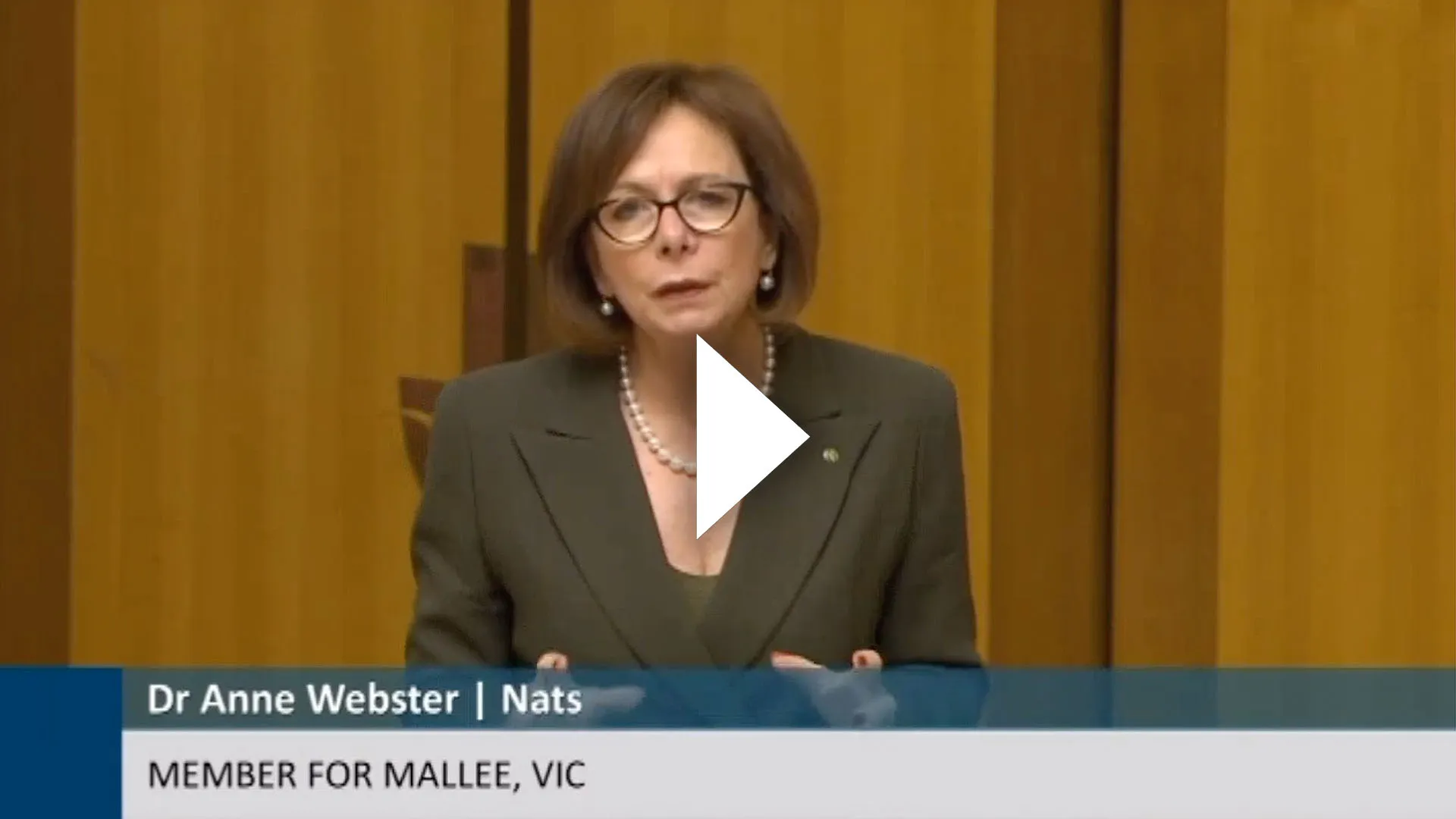

Interview with Matt Stephens, ABC Regional South Australia - Transcript - Friday 7 August 2026

Member for Mallee - Transcript - Interview ABC Radio Regional South Australia with Matt Stephens - Friday 7 August 2026
DR ANNE WEBSTER MP
SHADOW MINISTER FOR REGIONAL HEALTH
SHADOW MINISTER FOR REGIONAL COMMUNICATIONS
FEDERAL MEMBER FOR MALLEE
TRANSCRIPT
TOPICS: ACCC inquiry into regional telecommunications, mandatory domestic roaming, radio access network (RAN)
STEPHENS
You might remember a little while ago the idea was floated for Australia to introduce domestic roaming for mobile services. The idea would be that if you were outside of coverage for your provider and there was another provider in your area, you just switch to that one. Similar to how triple zero calls work, but for all phone and mobile services, the ACCC is stepping in now with an inquiry into regional mobile coverage, which will look at whether domestic roaming should be mandated, Anne Webster is the federal member for Mallee and Shadow Minister for Regional Communications. Anne, good afternoon.
WEBSTER
Good afternoon.
STEPHENS
Why is this something the Competition and Consumer Commission is looking into? Wouldn't it be better for the Communications and Telecommunications Authority?
WEBSTER
No, it's actually really important the ACCC step into this place. The fact is that out in the regions, people are incredibly frustrated with substandard telecommunications. The telcos are not that enthusiastic. Some are more enthusiastic than others. I've got to say, they've got less to lose, and they're not playing nicely in each other's space to agree. This is a financial issue for the telcos. Telstra, of course, is the largest provider, although not as large, as they've recently had to own their mapping has been a little bit out, and so the whole idea of domestic roaming is that, as you say, if you're driving through a town that has Optus as a tower, then your Telstra drops out, so there's no connectivity. I don't know about you, Matt, but I am one of many, many people who do a lot of driving in our regional areas. And even this week, I've been talking to people who live in three towns that have no connectivity once 3G dropped out, and we're left with 4G, so that's still ongoing. What the ACCC will do is look at the viability, to look at the need, and to look at whether they will actually make a declaration. So, this particular inquiry and the terms of reference are known as a declaration inquiry, which means that under the Telecommunications Act, if the ACCC declares particular services, then a telco has to allow competitors to access that service. We've got two terms of reference fundamentally under this inquiry. Number one is mandatory domestic roaming, and it's one I've certainly been on about for years - as has Sarah Henderson - and it's absolutely time for review. So domestic roaming is like, as you said, roaming overseas. You can get a signal. If one signal drops out, you simply … your phone jumps to another signal. It's all seamless theoretically, and when people come from overseas here, they can do the same. They can buy a little SIM card, and they can jump from tower to tower. It's just not available for Australians. So, the second term of reference is actually about the RAN or the Radio Access Network, and it would require carriers to share towers and radio equipment, and of course Telstra has poured out the most funding. But let's be fair; it's also been with a lot of government funding in there, taxpayer funding, and they would be required to share the towers or power supply for each of them. So, look at the moment we've seen a severe drop in funding. Around 50 per cent of mobile black spot funding has dropped under Labour, and even the funding that they did spend, they redirected it from mobile black spots into peri-urban mobile programs. So that was not great, and the other problem with it was that they actually spent the funding for mobile black spot on 75 per cent of their own electorates.
STEPHENS
Anne Webster is federal member for the Mallee and Shadow Minister for Regional Communications. You said earlier that this is a financial issue for the telcos, which is why the ACCC is involved. Why is it a financial issue for them? Because if I would thought if they're all sharing the network, then everyone's getting the same benefits.
WEBSTER
No. So Telstra, if you've invested in the towers, then there's a lot of money that's been invested. They're about a million dollars each. Some towers are funded 50 per cent by the government because they're not commercially viable according to the telcos. Telstra have paid for a lot of their towers, and they have the largest mapping. Although, as I said earlier, not as much as they've said stated publicly, but Optus owns very little. TPG, even less. So there needs to be a financial arrangement if this is going to go ahead. There would need to be a financial arrangement which is fair, hence ACCC have also done several studies on this already back in 2017, and then two or three others prior to that. So, it hasn't been as relevant, but it has now become because of the failures, because of the dropouts, because of the triple zero disasters that we've had, then ACCC is stepping in.
STEPHENS
ACCC have looked into this before, as you said, but has it taken such an interest in regional needs before as to what needs to happen in regional areas for mobile coverage?
WEBSTER
No. Well, if you're going to talk about mandatory domestic roaming, it is for regional. It's not actually for the city because there are so many towers in the city that it's basically - people are covered. It's out in the regions where we absolutely lose out, and even - you know - the National Farmers Federation are welcoming this inquiry, and their view is the same as my view, and the same as Sarah Henderson's view that they should mandate roaming now and let the ACCC work out the implementation later. It's probably … there's probably … you know, it is justifiable that the financial arrangement should be sorted out before, but yeah, look, the people out in the country feel this extensively, and we … like health, like roads, we're the people who are treated like second class citizens. So I, for one, am very grateful that the ACCC has stepped in. All those consumer groups who've been incredibly interested in regional telecommunications have been calling for this inquiry for some time. I'm looking forward to it. It'll take 12 months, and we'll see what ends up taking place.
STEPHENS
So, let's pretend that this inquiry in 12 months' time says yes, domestic roaming and other measures need to be put in place. What would happen from there? It wouldn't just be switched on, surely?
WEBSTER
Oh no, no, there would be – well, all those financial matters and business cases and - however ACCC ultimately decide it should be implemented, should they decide it's going to be implemented - then that would need to be actioned. The Labor government, Anika Wells, the Prime Minister, would need to back this, support this, and direct the departments to do their work as well. Nothing in government moves fast. I don't know whether you've noticed that, Matt, but nothing moves fast, and so it would be a matter of seeing what that inquiry says. But the Coalition is absolutely in support of mandatory domestic roaming. It's just how it happens, whether it happens at a wholesale level, whether it happens at a retail level, none of this is simple. I don't personally find it straightforward myself, so I don't blame anyone else if they don't understand it.
STEPHENS
It feels like we're going to be talking about this for a long time, given it's going to take 12 months for the inquiry to happen, but Anne Webster, I do appreciate your time this afternoon telling us about it.
WEBSTER
No worries at all. Thanks, Matt.
STEPHENS
Anne Webster is federal member for the Mallee and Shadow Minister for Regional Communications.