
Small businesses struggling under Labor's inflation crisis

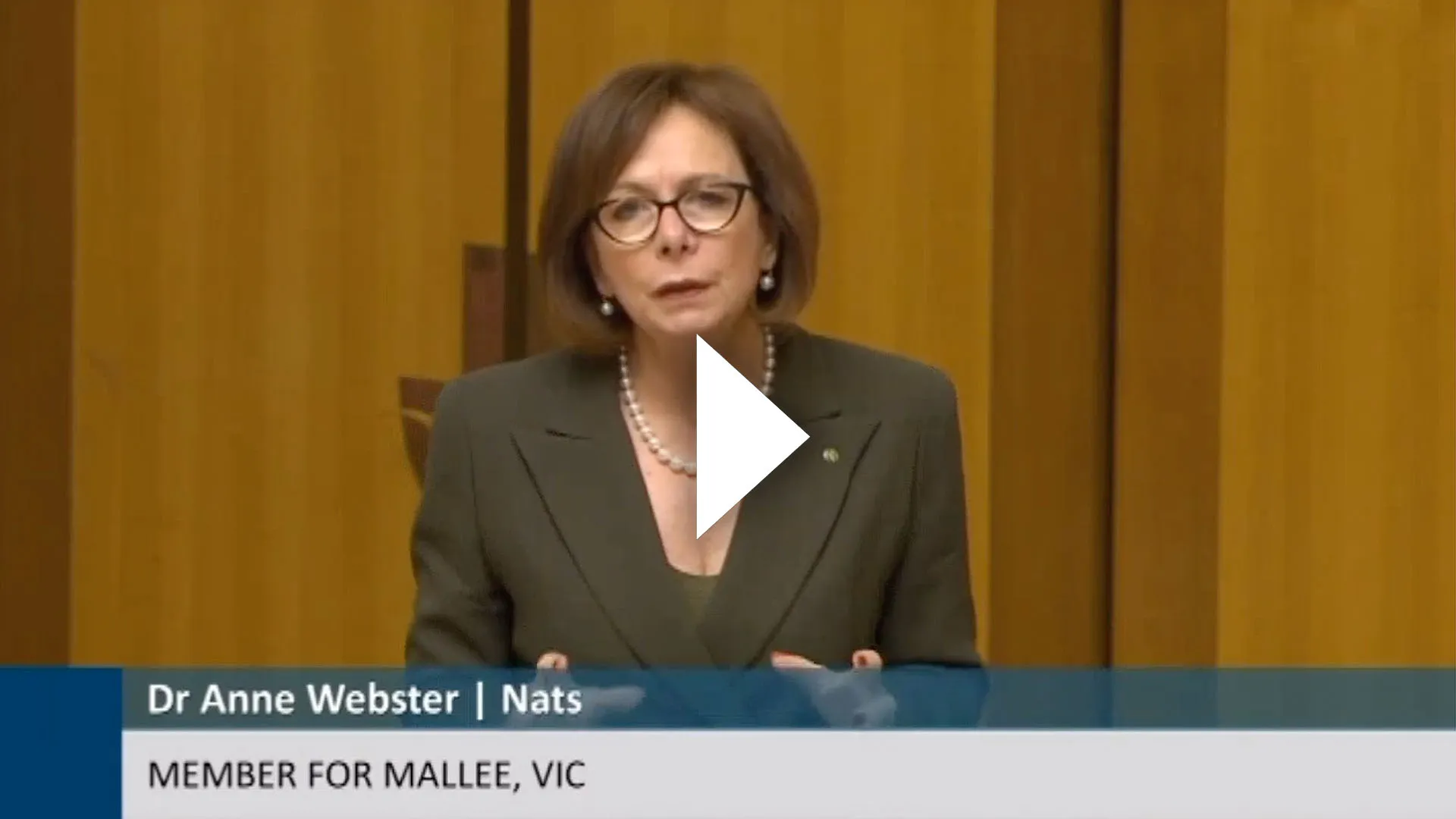
Dr WEBSTER (Mallee) (16:56): Small businesses are struggling under Labor's homegrown inflation crisis and their energy crisis where $275 in energy savings never materialised. Now add to that the fuel supply crisis, which isn't just hitting direct fuel purchases but also hitting small businesses and farmers who struggle with the knock-on effect on fuel as part of their business inputs.
We are also seeing eye-watering increases in the cost of trade goods, like PVC pipe, which is up 35 per cent in the last month alone. Copper is up seven per cent in the last month and up 37 per cent over the last year. We have record insolvencies in small business—40,000 on Labor's watch since taking office and 15,000 in the last 12 months alone. About 27 per cent of insolvencies are in the construction sector, the largest single sector for insolvencies. It's little wonder we are struggling to build more homes.
In this witches' brew of Labor's homegrown crises for small business, what is the Albanese government's solution? You guessed it—more red tape in more consumer laws. Let's be up front about what this will cost small business. Treasury estimates the bill will impose $123.2 million a year in regulatory costs. The general prohibition measure alone, which I will talk about in a moment, accounts for $93.82 million a year in extra compliance costs. More than 1.5 million small businesses are expected to be affected by the general prohibition alone.
This bill creates a broad new general prohibition, which I referred to earlier, with $93 million extra cost on small business, Treasury estimates, from this single provision on unfair trading. So what is it? Proposed section 28B provides that a person must not, in trade or commerce, engage in conduct in connection with the supply or possible supply of goods or services to a consumer that manipulates the consumer or unreasonably distorts the environment in which the consumer makes or is likely to make a decision and causes or is likely to cause detriment, whether financial or otherwise, to the consumer. On face value, this government's salesman-in-chief, Treasurer Jim Chalmers, and gaslighter-in-chief, the Prime Minister, would fail that test alone. Manipulating Australians? Tick. Unreasonably distorting the environment in which they make decisions? Tick. Causing detriment, financial or otherwise? Tick. But it gets worse.
Supposedly, according to the explanatory memorandum, 'detriment' could include wasted time, frustration or diminished consumer choice. Do Labor waste our time? Do they cause frustration? Have they diminished consumer choice?
This Labor government is imposing on small business thresholds on manipulation, distortion and adverse impacts that they themselves cannot uphold. This Labor government can go out into the marketplace 97 times saying, 'You'll get a $275 energy bill discount,' and not deliver—and that's okay, apparently. This is a prime minister who says 'nobody worse off, nobody held back', yet last night's budget picked winners. And some Australians will be worse off— particularly those in the regions, those with savings and older Australians. How would the 'nobody worse off, nobody held back' slogan stand up on the unfair trade practices test? This is a government that cannot practise what it preaches.
Courts have held that detriment can include feelings of distress or embarrassment. So a business acting in a way that causes distress in the eye of the beholder, the consumer, could breach these laws. Seriously? If your spicy McChicken burger is a little spicier than you expected, is that a detriment? Well—not for some. But—really? This will be a lawyers' picnic. It will play through the courts for decades to come and create great uncertainty for business and consumers alike.
A clear winner of the uncertainty this general provision creates will be the biggest businesses that can afford the biggest legal and compliance teams or advice from big law firms. I get that the Treasury would want a broadly drafted law. But forgive me for not accepting the Labor government position to just trust them to apply a broadly drafted law narrowly and responsibly.
A question a Senate inquiry might ask stakeholders is whether they specifically wanted a broad general prohibition, as this government has put forward. Consumer stakeholders may have wanted action taken, but did they want a government sledgehammer to smash small businesses with? Make no mistake, small business will suffer under this bill. At last check, 75 per cent of small-business owners were taking home less than the average wage. That's $1,000 a week or $52,000 a year. That was according to the Australian Small Business and Family Enterprise Ombudsman in 2023. At that time, incidentally, 43 per cent of small businesses were failing to make a profit. Now these same small-business owners will lose more sleep at night wondering if they will be taken to the ACCC or to court for causing an emotional detriment to their customers. More small businesses will fold, and big business will muscle in. Maybe that's Labor's agenda: collapse small business and the big boys will move in.
Well, that's how it plays out usually in the cities—franchises and the like. But in regional Australia what happens is the small business closes, landlords can't rent out the commercial premises, and the town becomes a ghost town. That's the real impact of adding yet another straw of regulation during terrible business conditions. Small-business owners will throw up their hands and simply give up.
We can't afford to lose more small businesses in regional Australia. Huge numbers—over half, in one recent survey—were already considering closing their doors. The big businesses that can afford to pay for the big law firms to advise them on this new law—will they wear it? No, I don't think so. Red-tape costs are passed down to customers. In an attempt to protect consumers, compliance costs will be fed down in increased prices for consumers during Labor's homegrown cost-of-living crisis. Will small businesses be able to use this general prohibition in their dealings with larger businesses, as the Australian Small Business and Family Enterprise Ombudsman called for in the consultation phase back in December 2024? I am just trying to get a sense of how wide and hardhitting this general prohibition will actually be.
Another piece from the Labor playbook here is the very thin veneer of public consultation. The exposure draft of this bill went out for consultation for only two weeks. That's why this bill should go to the Senate Economics Legislation Committee. A Senate inquiry should test whether the general prohibition is too broad, whether the definition of 'detriment' is too wide and whether small businesses should be exempted or given more time. It should give stakeholders more than two weeks to make their views on this law known. Nobody has a problem with protecting consumers, but the pathway there isn't a lawyers picnic—unless, like Labor, you have some business mates you want to look after by obliterating small business. Where are the exemptions or delayed phase-ins for small businesses?
This is a bill that needs a lot more work and a lot of scrutiny in the Senate. I commend the shadow minister, the member for Page, and the coalition ministry team for the important work they have done on holding this government accountable for a badly drafted law that imposes crippling costs on businesses, particularly small businesses, when they can least afford it.