
Labor's man-made drought puts regional jobs and Australia's food security at risk - Media Release

Tuesday 25 August 2026
The Albanese Labor Government's latest $430 million Murray-Darling Basin water buyback has taken almost 86 gigalitres of productive water out of agriculture, pushing Labor to within 70 gigalitres of their 450 gigalitre political water buyback target.
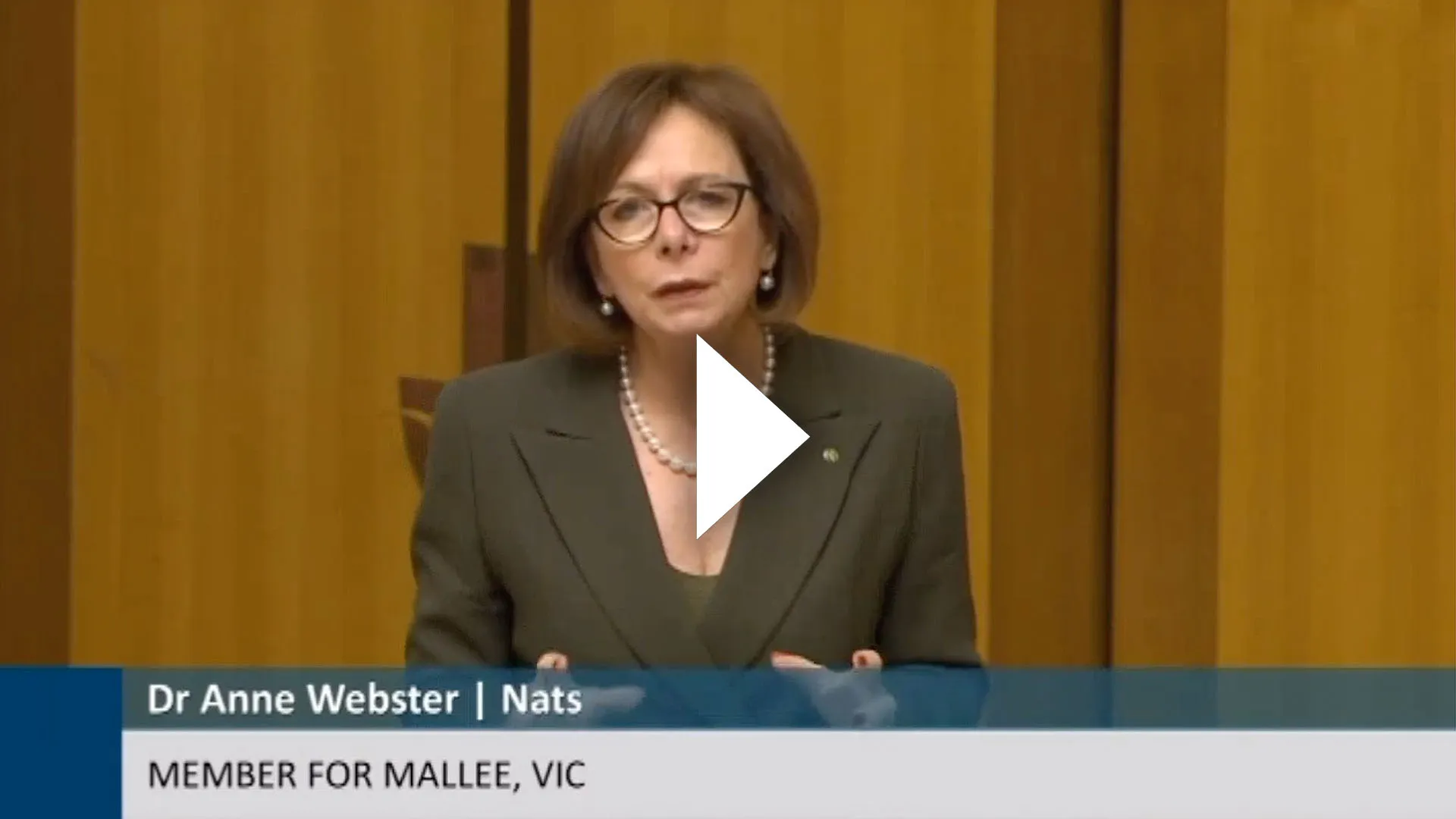
Member for Mallee Dr Anne Webster said the buybacks are destroying food and fibre production as farmers struggle to gain access to the water they need at a price they can afford.
"Across northern Victoria and southern New South Wales we are seeing jobs disappear, food manufacturers sounding alarm bells and irrigation communities increasingly worried about their future as buybacks compound ongoing seasonal and workforce challenges," Dr Webster said.
"While Labor calls it ‘water recovery’, regional Australians are experiencing Labor’s man-made drought."
Dr Webster said Australia's own agricultural economists ABARES had already warned that a 225 gigalitre recovery scenario (half the 450 gigalitre target) would increase water allocation prices by 9.5 per cent and reduce the annual value of irrigated agricultural production by $111 million, with Northern Victoria expected to suffer the largest reduction in irrigation water use in the Southern Basin.
"Now we are seeing major employers such as SunRice reducing jobs and processors such as Kagome warning that rising water costs are threatening their long-term viability in Australia,” Dr Webster said.
"Victoria had already contributed 786 gigalitres under the Basin Plan before 2022 and, since the Albanese Government came to office, a further 137 gigalitres has been taken out of consumptive supply from Victoria."
"Every buyback shrinks the consumptive pool, puts greater pressure on the remaining water and undermines irrigation communities’ productive capacity."
Dr Webster said Labor had consistently removed more and more productive water from agriculture and horticulture when the governments already controls vast volumes of environmental water.
As of November 2024, the Commonwealth Environmental Water Holder held approximately 2,940 gigalitres of water entitlements and was carrying over more than 30 per cent of annual allocations, with more than 50 per cent carried over in a recent reporting year.
"Before Labor governments continue spending billions creating water scarcity in river communities, we need to know why existing environmental water holdings are apparently insufficient – and why the CEWH isn’t selling excess entitlements back to irrigators."
"This is a classic Labor and socialist ploy. They remove productive water from communities and drive up water costs through created scarcity. Then, they announce another taxpayer-funded package to manage the damage Labor caused, but the money lands on Labor political targets, not where it is needed most."
“We’ve seen it again recently with financial support offered to Sunrice after it let go of workers due to Labor’s anti-agriculture policies.”
Dr Webster said communities hardest hit by buybacks had repeatedly warned that so-called compensation funding was failing to address the permanent economic losses caused by removing productive water from regional economies.
"We were promised support for affected communities. Instead, local councils and community leaders continue raising concerns that funding intended to offset buyback impacts has not reached the communities carrying the biggest burden."
"A one-off grant can never replace the long-term economic value of productive water."
Last week the National Irrigators' Council, NSW Irrigators' Council, Ricegrowers' Association, Citrus Australia and Cotton Australia jointly warned that Australia's food security strategy cannot ignore water as a critical input into food production and argued that 'water policy is food policy'.
Leader of The Nationals Matt Canavan warned The Nationals’ Federal Conference earlier this month that Australia is sleepwalking into a food security crisis because our population has grown by 50 per cent this century while our food production has grown by only 30 per cent.
The Nationals' modelling shows Australia could face significant shortages in domestic production of everyday foods by 2040 if current trends continue.
Dr Webster said Labor is deliberately taking water away from the communities that grow our food at precisely the time Australia needs to strengthen food production.