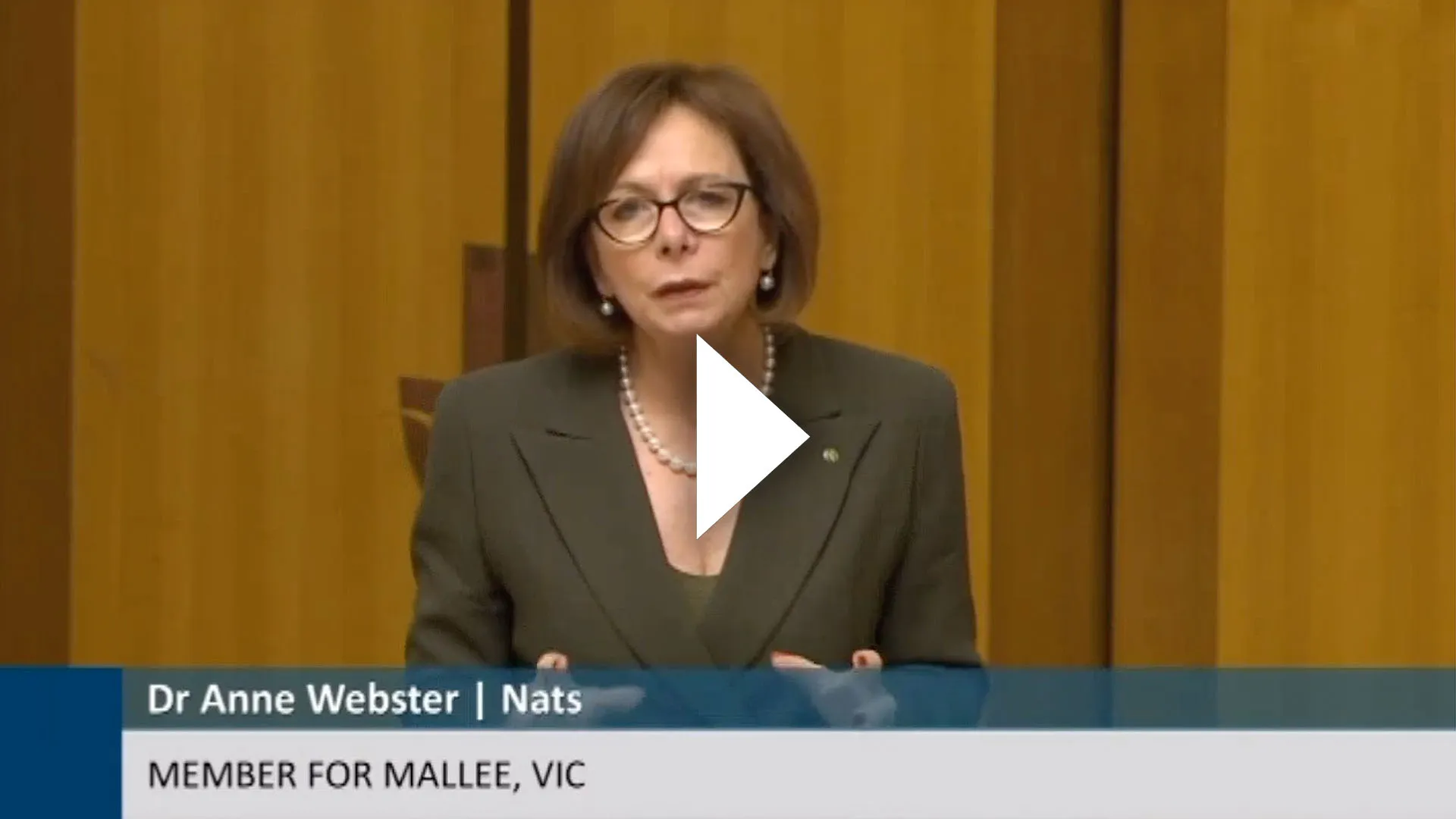

Interview with Stephanie Nitschke, ABC Riverland Breakfast - Transcript - Wednesday 18 November 2026

Member for Mallee - Transcript - Interview ABC Radio Riverland - Breakfast with Stephanie Nitschke - Wednesday 18 November 2026
DR ANNE WEBSTER MP
SHADOW MINISTER FOR REGIONAL HEALTH
SHADOW MINISTER FOR REGIONAL COMMUNICATIONS
FEDERAL MEMBER FOR MALLEE
TRANSCRIPT
TOPICS: aged care infrastructure investment, Support at Home, lack of aged care beds for discharge from hospital beds, aged care assessments, Senate inquiry on Support at Home
NITSCHKE
Now, aged care is an issue we've been talking about a lot on this programme with thousands of people across Australia waiting in hospital beds for an aged care assessment to determine the level of care they need. And while people in the Riverland struggle to find aged care beds, it turns out our neighbours across the border are facing similar challenges. Dr Anne Webster is the Shadow Minister for Regional Health and Federal Member for Mallee. Good morning. How are you?
WEBSTER
Good. Thank you.
NITSCHKE
Now, Mildura is a regional centre, quite a big place compared to, say, Renmark, where we are. So, if the situation in Mildura with aged care is tight, what do you think that says about the system in smaller communities where there are less services and facilities available?
WEBSTER
It is a huge problem. I have people from actually all over Australia because my portfolio is Shadow Minister for Regional Health. A lot of people contact me about the lack of aged care facilities, plus Support at Home services and Commonwealth Home Support Packages that are available. Where they live, particularly out in the regions, we generally have older populations, so we have more people who are needing support, and yet we have thin markets. And by thin markets, I mean that we don't have the workforce to meet the need where we live, and that just creates this rolling problem where we have people who are in hospital. I note in your report that you've said 500 people were medically cleared to leave hospital but had nowhere to go. I read this morning a thousand in New South Wales are in the same position, and in fact there are 4,000 people in hospital beds right now across Australia who are cleared to leave, but there is nowhere for them to go. They either have not been assessed for a care package and/or both. It hasn't been delivered, or there is no bed in a residential aged care facility and I'm really mindful that people actually don't want to go to an aged care facility. That's not our goal in life. Most people want to be able to age safely and well at home. And the Support at Home system, which has now been operating for 12 months, has got serious problems, and especially in the regions.
NITSCHKE
What do you think the barriers are to attracting and investing in aged care facilities in regional areas, even from the private sector?
WEBSTER
The providers for aged care facilities - so we're talking about residential aged care - they are telling me that the ANAC has not been increased sufficiently for them to make ends meet. It's not just that; if they need to expand, as certainly as the case here in Mildura, we've got an aged care facility or two who are trying to expand. The funding that they were approved for a couple of years ago, unsurprisingly, can't buy what the funding was meant for, so everything is chopped down - in the environment that we find ourselves in, with higher interest rates and inflation and supply chain restrictions - and that's the aged care facility itself. But Support at Home packages are the other problem, you know, the Families for Aged Care Equity and Support (FACES), gave Labor's Support at Home system an overall D grade, and an F for safety. And the average Australian is waiting 297 days before they can receive services, that's why we're facing this reality that four thousand people are in hospitals, and of course, hospital beds, I should say, and worse, 6,400 have actually died while waiting for aged care services to be provided. That's 17 people a day. Aged care is really impacting a lot of people, and there are many people who can't get assessed. And when they are assessed, it's by phone. I find that one of the most outrageous and inconsistent lack of equity positions that we are in. Now that people in the regions have an allied health person who is doing an assessment for the aged care package, and they are assessed on the phone. Now I know that you would know as well as I know people who are older. My mother's ninety, or about to be, and if people ask her how she's going at home, she'd say, "Fine, I'm fine." It's only by actually going and visiting. And I'm not saying my mother has issues. She's actually very spritely for her age. But there are plenty of people who would say, and you think about the farmers, those stoic farmers, 'Oh, I'm fine. I'm okay, I can do that, or I can do that.' It's only by going to someone's house and seeing how they get out of a chair, how they can open doors or cupboards or turn the kettle on or cook for themselves, or what the condition of the home that they need assistance. I think phone assessments, frankly, should be banned. And then, of course, on top of that, you've got the algorithm. Anne Ruston has done sterling work on calling out this algorithmic final summary of the assessment, and that it is proving to be a serious problem. I think that Labor need to be doing a lot more, as I have said to Sam Rae, to his face, and Mark Butler as well. They need to take this seriously.
NITSCHKE
If you're just joining us, we're speaking with Dr Anne Webster, who is Shadow Minister for Regional Health and Regional Communications, Federal Member for the Mallee, and you know the Senate inquiry examining pricing and co-contributions hospitals reports on Tuesday, the 24th of November. That's next Tuesday. What actions are you hoping this report will bring?
WEBSTER
I hope that there is a real call to action with regard to pricing in particular. I find it really disturbing disturbing that people are paying $1,400 dollars now for costs that were $300. That just makes no sense to me. And the thing is, with the Support at Home packages, that is similar to the NDIS in the sense that they are individual packages, and it's based on that assessment that I just spoke about, and the algorithmic determination. So the package is what it is, and it'll be between $11,000 a year to $80,000 dollars a year, depending on the level of need. The problem is that when the delivery of services goes through the roof, you obviously get less services for your dollar. So people are running out of money to have a shower. They're having to cut down on the number of showers they have a week, or cut down on the number of times their grass is mowed. For providers to be able to charge what they're charging, I mean, Mark Butler says, you know, it needs to be transparent, needs to be reasonable. What's that? And especially when they're not transparent, the fees are not transparent, and people are finding their bills are coming in, and shock horror, they've got nothing left in their account. So what are they going to do now? Not have a shower. For the next, or not have allied healthcare, or whatever it might be, for them to stay at home safely, they now can't afford it because their dollar is not buying, or their package is not buying what they actually need. It's a real problem. We are in a world of pain, and I really hope that the report from the Senate highlights the issues and how pricing has been allowed to be run away with. Why are the aged care providers themselves not being held to account properly? And why is it that we have so many people who are dying while waiting or in hospitals when they need to be out of hospital.
NITSCHKE
Thank you so much for your time today, and we appreciate your thoughts.