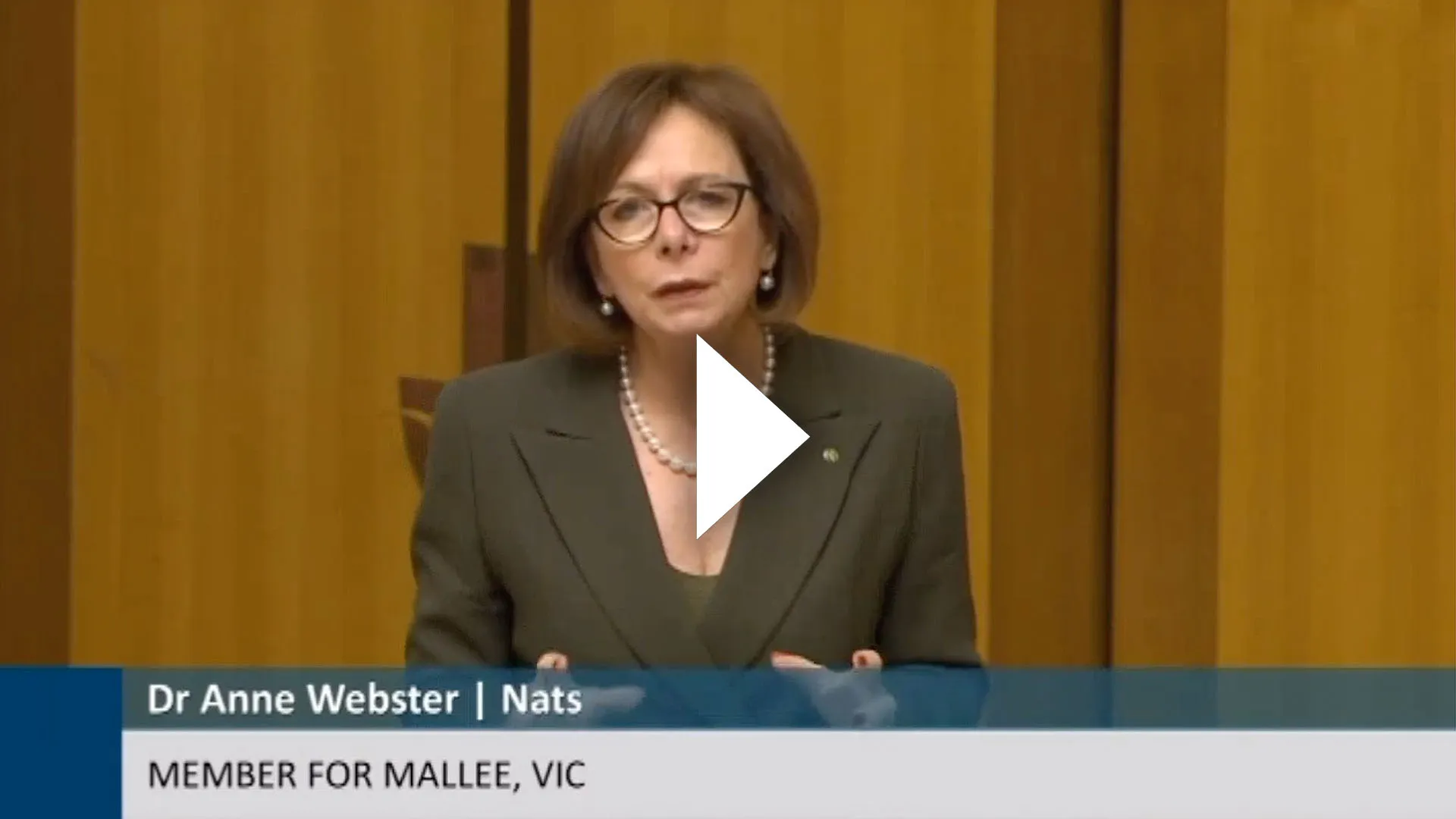

Labor attacks farmers again with more red tape on exposure limits - Media Release

Wednesday 5 August 2026
Australian farmers are under attack yet again from Labor Governments, this time on key chemical phosphine used to protect stored and transported crops, Member for Mallee Dr Anne Webster said today.
Speaking from Mallee Machinery Field days at Speed on Wednesday and Thursday, Dr Webster said farmers had contacted her furious that new rules coming into effect in December mean farmers will be expected to apply phosphine exposure levels six times lower than current standards, and at a strict standard not applied anywhere in comparable countries.
“Time after time Labor is dismantling our economic base in regional Australia, applying unworkable conditions in our primary industry – agriculture – and turning us into an industrial wasteland of turbines, panels and transmission lines,” Dr Webster said.
Grain Producers Australia director and Mallee farmer Andrew Weidemann said the proposed new phosphine standard will devastate grains farming.
“We don’t even have the instruments to measure the proposed levels - grain storage, freight and export will all suffer, and many in the grains industry will be put out of business,” Mr Weidemann said.
“GPA is calling on the Federal and State Government to halt December’s implementation date for phosphine and listen to industry on a common sense approach.”
Dr Webster noted a Worksafe Victoria analysis in October indicated that implementing the proposed federal workplace exposure limit (WEL) changes would cost Victorian businesses approximately $6.3 billion over 10 years, compared with estimated quantified benefits of approximately $2.9 billion over the same period. Construction, manufacturing and agriculture industries were expected to be most impacted by the changes.
“The Albanese and Carroll Labor governments have both also shown utter disregard for farming, as state governments have put a hold on new strict limits for 9 substances (respirable crystalline silica, formaldehyde, benzene, chlorine, copper fumes etc, hydrogen cyanide, hydrogen sulphide, nitrogen dioxide and titanium dioxide) but not phosphine,” Dr Webster said.
“Crop quality (and therefore farmer incomes) will degrade without these protections, and as Labor allows our exporters to be battered by trade headwinds, they are making chemicals significantly harder and more expensive to use to maximise returns for farm produce.”
“This is the paraquat and diquat debate all over again – bureaucratic actions for a pat on the head from the union movement with absolutely no real-world consideration on the impact on farmers, their legitimately held views, and farm productivity.”
“Let me be crystal clear, as Shadow Minister for Regional Health, it is incredibly important we protect farmers and workers’ health. What is lacking here is an evidence base that these limits are warranted, and there has been a lack of exploration of other means to ensure any unsafe exposure can be mitigated in other ways.”
Phosphine prevents insects spoiling stored grain, commonly applied through aluminium phosphite tablets or pellets that slowly release phosphine gas.
A Safe Work Australia directive will see phosphine use reduced from 0.3 parts per million (ppm) time-weighted average (TWA) exposure for a worker over a working day, to just 0.05ppm – a sixfold decrease. The Victorian Government plans to implement that standard from 1 December.
Dr Webster said Labor’s proposed Australian standard is half the strictest in the comparable grain-growing jurisdictions.
“The EU applies a 0.1 ppm TWA standard, while the US, New Zealand, the UK and Canada’s main grain-producing provinces – similar jurisdictions and our main global competitors – are all at our current 0.3 ppm TWA level.
“Yet again, as with net zero and a host of Labor’s other virtue signals to the world, the Albanese Labor Government is throwing our economy and farmers under a bus to compete in a red-and-green tape beauty contest nobody genuinely wants to win.
The Worksafe Victoria analysis noted for the new phosphine standard:
Agriculture: Longer ventilation periods post-fumigation to meet the lower WEL values may cause supply chain delays and operational downtime, with costs likely to be passed onto end customers where possible. One industry group noted that for phosphine, the primary fumigant used in stored grain, existing detection methods may not reliably measure concentrations at or below the WEL value, posing practical challenges for compliance
Dr Webster highlighted that the Worksafe Victoria Regulatory Impact Statement failed to analyse to an industry-by-industry level, like agriculture, the impact the proposed standards would have.
The new standards also impose new lower limits on methyl bromide – a key fumigant for grains, pulses, nuts and some fruits – reducing from 5ppm TWA to 1ppm, and new first-time limits on:
· diesel particulates (0.01 milligrams per cubic metre (0.01 mg/m3) and
· 0.1 mg/m3 for herbicide diquat, despite the federal regulator APVMA currently requiring a 0.3 mg/m3 on product labelling.
Dr Webster said that yet again Labor had shown utter disregard for the responsible and safe way farmers operate.
“As we saw in the paraquat and diquat debate, farmers know that it is unsafe, wasteful and costly in difficult growing and trading conditions to apply any more chemicals than are absolutely necessary, Dr Webster said.
“Labor’s view is always that government knows best – it is condescending and does not respect the lived experience of farmers.”