
Interview with Grace Marshall, ABC Mildura and Swan Hill Breakfast - Transcript - Thursday 27 August 2026

DR ANNE WEBSTER MP
SHADOW MINISTER FOR REGIONAL HEALTH
SHADOW MINISTER FOR REGIONAL COMMUNICATIONS
FEDERAL MEMBER FOR MALLEE
TRANSCRIPT
TOPICS: Cuts to private health insurance rebates, Mildura public hospital impact, Government modelling on impact, public surgery wait times, Modified Monash Model reform, federal-state health responsibilities and funding, interaction of private and public hospitals, opponents of Labor’s private health insurance policy
Marshall
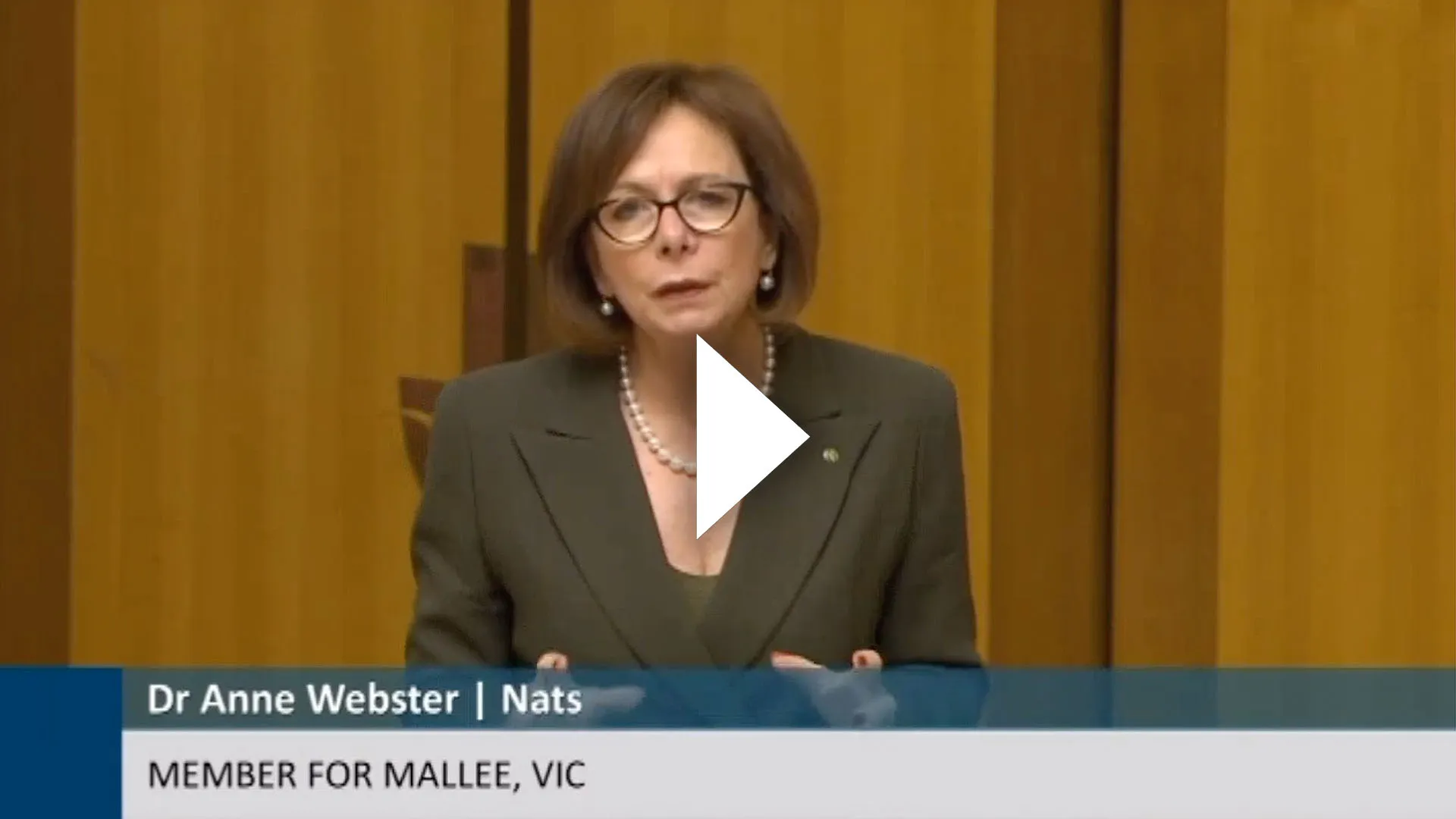
Now living regionally, we all know how hard it can be to see a specialist. Sometimes you have to travel interstate to Adelaide, or even over the border to New South Wales, or all the way down to Melbourne. Even getting in to a GP can be hard as well. This all adds in extra time, extra costs. Well, now imagine adding an extra cost to the amount you pay on your private health insurance. And as you just heard back in April, the federal Health Minister Mark Butler did announce changes to the private health insurance rebate. But the insurance sector estimates 62,000 older Australians might drop their cover, and as you heard from Sue in Mildura just before, she's looking to potentially have to drop her cover. She doesn't want to, but she's wondering how she can afford these changes. The Australian Medical Association has warned that these proposed changes could increase the pressure on our public hospitals. We do know that our public hospitals do have a lot of pressure on them at the moment. Dr. Anne Webster is the federal member for the Mallee. She is also the Shadow Minister for Regional Health. She joins me now. Good morning. Good morning, Grace.
Webster
How are you?
Marshall
Well, thank you. So, just like Sue, who is feeling the impact of these potential changes, what could this look like in Mildura and this region if these changes do come in?
Webster
Well, it would be very concerning. We already know that the Mildura Base Public Hospital is struggling to meet the need, and so with private health insurance rebate, let's be clear, it's for those over 65 who have often been paying taxes all their lives and investing in their own private health insurance, so that when they get to 65 and above, they would be able to have their cataracts or their knee surgery or their hip surgery, all the things that break down over time, and not have a two to three year waiting list in the public system because that's where we're at right now. So, private health insurance allows you not only to theoretically choose your doctor - it's harder in Mildura, I've got to say - but choose your doctor and have the surgery in the private hospital. So, what we have is with these changes, with the reduction on the rebate for those over 65 and 70, that a couple could be paying $1,600 a year extra. When you're on a fixed income, such as a pension, and a vast number are on a pension, that's a lot of money. So, we have the insurance sector estimate that 62,000, as you said, older Australians will drop their cover altogether. But they're also estimating around 200,000 will downgrade their cover. The government won't show their modelling. They say only 44,000 will be impacted, but National Seniors Australia are saying 400,000 will reduce their cover, and 270,000 will drop their cover altogether. That places enormous pressure on the public system, and what we've got now is the state governments, including two that are Labor - New South Wales and South Australia - as well as Tasmania and Queensland, are all pushing back on this change because they know, as they run the public hospital sector, they just can't do it. I mean, we don't just have ambulance ramping; we have these years of people… you know, it's not just waiting around for a cup of coffee … they're in pain, or they can't see, and they need these surgeries. And two to three years is horrendous for anyone.
Marshall
We know, and that Mildura Base Public Hospital has been under the control of an acting chief executive since Terry Welch did leave the organisation without notice one month ago. The hospital is yet to confirm the reason for his departure. Mildura is also an ageing population, so we have this pressure on our hospital. Is this going to have more pressure in a town like Mildura? Will we see Mildura in Victoria potentially suffer the worst of this?
Webster
Look, Mildura … I've been doing quite a bit of work in this space as Shadow Minister for Regional Health. It frustrates me enormously that people who live in Mildura and surrounds who rely on the Mildura Base Public Hospital have enormous wait times. They can't see a specialist. Obviously, we've seen it publicly stated that the Hospital has been relying on locums and agency nurses and can't therefore manage the costs of running the Hospital, then we've got of course the departure of the CEO, and people are left with the choice to wait it out here, or wait it out in Melbourne, potentially some in Bendigo, but the problem is when we talk about the Modified Monash Model, which determines the area of need for workforce shortages for distance, it does not actually calculate accurately the distance to the next tertiary hospital. Mildura is an outlier, and it never comes out in the current framework of the MMM that the whole of Australia is organised by, shall I say. So, we're Triple MMM3, and that means that there are particular investments that are not being made that should be made, in my opinion, I very strongly believe that, and the people of Mildura and surrounds who rely on the public hospital and the private hospital are not getting the care or the investment in specialists, etc. Then we're at the mercy, let's not forget, we're at the mercy of flights, like this morning, it's all fog. So, specialists are supposed to be coming up today to do surgery. They won't be, and that means further delays for people who are waiting for that surgery. It’s a mess. It’s a serious mess. I am determined to make a difference.
Marshall
Do you think, with these changes and people like Sue who are suggesting they could potentially leave the private health system – if people in Mildura do start cancelling their private health – will we see private health specialists leave the region?
Webster
Well, it’s possible. In an ideal world, Grace, we would have the private hospital and public hospital having a stronger shared arrangement. I am not in the weeds of how that is working…
Marshall
… Is that what Mildura’s healthcare industry needs right now? That collegiality?
Webser
Well, we do - there is collegiality, I am not pointing the finger at anybody. But we need a better sharing. The federal government manages the private sector, the state governments public the public hospital sector, but there is a split where federal and state governments are investing $450 billion dollars over 5 years for hospitals. My focus is on primary healthcare, preventative primary health care, so less people actually need the surgeries, and people don't need to go to hospital because that is an incredibly costly process. And let's face it, nobody wants to go to hospital if they don't need to.
Marshall
With these changes that Mark Butler announced early in the year, he said it would potentially save the budget about $3 billion a year. Are there other changes to private health that you think, and that could come in, rather than that, that could help that save that money?
Webster
Oh, look, Mark Butler has said that it's an $11 billion saving, $3 billion in the first year, $1 billion every year after that. I don't think that it's fair to make those changes on older people again who have invested, all of their years, and his argument that a young family in one house, house A, and an older couple in house B should pay the same in their health insurance. Well, the older couple did pay the same as the 25-year-old.
Marshall
Do you think there should be over-65 concessions for people who have potentially, like Sue, been on a private health service for 60,70, years?
Webster
Well, that's what the rebate's about. It's about trying … this is why John Howard brought it in, is to try and keep people in private health insurance so that the very complex health system that we have, can roll along, and I use those words probably completely inappropriately, but so it can actually be managed. We need people who are in private healthcare, and we need people who are able to access public healthcare.
Marshall
So what's the next steps moving forward then?
Webster
Ah, we're absolutely fighting Mark Butler, and so is the insurance industry. So is the Private Hospital Association. So are National Seniors who advocate for older people. Nobody thinks this is a great idea, as you said, AMA are not impressed. So, we'd like to see Mark Butler walk this back. They have not shown their modelling. They've not shown their stakeholder engagement. This is really typical of how they're playing right now. They make the legislation, they make the policy move, and then they do the consultation and stakeholder engagement. It's just backwards, and it results in very bad outcomes for those living, particularly my focus is on, in the regions.
Marshall
Well, we will need to leave it there this morning. We will be speaking to Mildura Private Health Fund tomorrow morning and continuing this conversation. Thank you so much for your time this morning.
Webster
No worries. Thanks, Grace.
Marshall
That's Dr. Anne Webster there, she's the federal member for the Mallee. She's also the Shadow Minister for Regional Health.