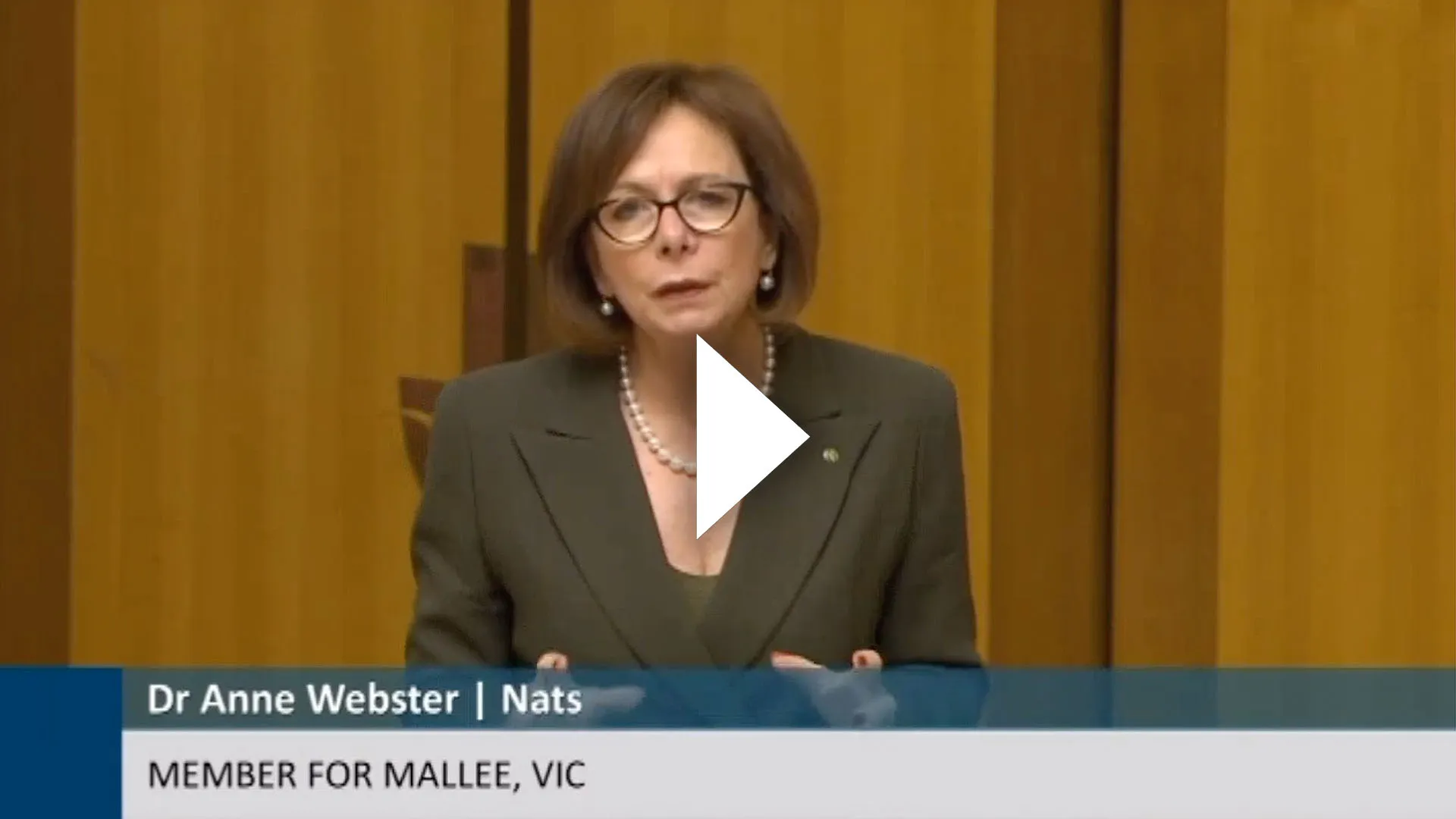

Interview with Caroline Marcus, Sky News 'Kenny Report' - Thursday 5 March February 2026

Shadow Minister for Regional Development, Local Government and Territories, Shadow Minister for Regional Communications - Member for Mallee - Transcript - Sky News - Thursday 5 March 2026
DR ANNE WEBSTER MP
SHADOW MINISTER FOR REGIONAL DEVELOPMENT, LOCAL GOVERNMENT AND TERRITORIES
SHADOW MINISTER FOR REGIONAL COMMUNICATIONS
FEDERAL MEMBER FOR MALLEE
TOPICS: Conflict in the Middle East, Australian fuel supplies, business investment conditions, biofuels, protecting prime agricultural land, renewable energy projects and targets, farmers’ property rights, renewable energy subsidies
MARCUS
The conflict in the Middle East has raised some serious concerns about our nation's fuel supplies, with a major shipping route, the Strait of Hormuz, effectively closed. Energy Minister Chris Bowen has downplayed concerns about supplies and price hikes, arguing companies are required to keep a minimum amount of stock on hand. Joining me now to discuss this and more is Shadow Minister for Regional Development, Anne Webster. Dr Webster, thanks for your time tonight. Firstly, do you accept Chris Bowen's assurances here about our fuel supplies?
WEBSTER
Well, Carolyn, thanks for having me. Does anyone accept Chris Bowen's assurances about fuel supplies any
more than we trust him about electricity prices to come down? I mean, I could go through a myriad of things that Chris Bowen says, that certainly give me no comfort and I'm sure don't give Australians comfort. With the growing uncertainty overseas, Australia I think, you know, often we need to be motivated for change and motivated to find what is needed to develop the things that we need to have as a nation. Our own fuel supplies and having enough in reserves is one of them. But, you know, I understand why industry would not want to be backing or investing in refining in Australia so much, because the economic platform that they've got to deal with, the IR laws, the red tape, the green tape, you name it, are so difficult that they discourage investment. At this point in time, the Labor government needs to get off its hands and deal with all the barriers that stop this kind of investment happening. I think the other area too, Carolyn, is that biofuels are a thing, are a real thing. They're really happening. 70 per cent of Australia's canola, which is grown in my patch, goes to the EU at the moment and is refined into diesel in the EU. It sounds incredibly costly. Apparently, it works. Why are we not doing that in Australia? You know, sugarcane, again, up north. There are particular varieties … last night I had the privilege of being at the Japanese embassy and looking at particular beans - don't ask me what the name name is, it's something like pomgania, which grows in salt environments - I probably got that wrong - Salt environments and doesn't need a lot of water and they're using that for fuels. There are so many options, and we should be an environment in Australia where we can invest in this and private enterprise can invest in this and see it flourish.
MARCUS
Yeah, you're right. I mean, we're still waiting for that $275 discount off our electricity bill. So, how can we trust anything Chris Bowen says at this point? Meanwhile, your Bill to protect prime agricultural land from renewables projects has been tabled in Canberra this week. How would this legislation protect farmers across the country?
WEBSTER
So, fundamentally, it works on … and I've got to give a shout out to Alison Penfold, who actually delivered this in the House - the National Party Room stands behind it, now it's got to go through all the processes as a Coalition. So we'll continue to develop that. But the legislation deals with determining what quality land exists in agricultural land. At the moment, in Victoria - and we've seen more emergency laws today come into play where ag land is completely devalued by the government because they are trying to hit Chris Bowen's energy targets and trashing our agricultural land - the Bill goes to define tier one, tier two, tier three of agricultural land to determine what is prime, what is the next level, and then marginal land. Do what you like with marginal land, basically, nobody cares. But when you're dealing with prime ag land, which is most of my electorate, farmers' rights are being utterly trashed. And the Commonwealth legislation that I have put forward through Alison Penfold is using Section 96 of the Constitution, which is about Commonwealth funds and how they can be delivered (or not delivered), the parameters around where we would not deliver funds to states, territories or other entities, including private enterprise, for that much. At the moment, the Labor government is subsidising to the tune of who knows how much, Carolyn, billions, but how many billions, we don't know, to have these renewable projects and the transmission lines and everything that goes with them subsidised. So, under this legislation, if it becomes Coalition policy, and of course that's to be determined yet, and goes into our portfolios into the next election, we would stop that funding. And what would happen then? Well, I think it's pretty plain. The people who are drinking from the teat of the government expenditure and funding would cease to be so engaged with that process. So, what we want to see … I'm using whatever I can at a federal level. A lot of these laws are state. I acknowledge that, but as a federal law, there is more to be done. And, you know, the mapping...
MARCUS
Well, there certainly needs to be...
WEBSTER
...Tier 1 ...
MARCUS
Yeah, there certainly needs more to be done, Anne Webster, because people are concerned, you know, and we're trying these ridiculous things to meet these renewables and energy goals that will have no tangible effect on the environment anyway. We've got to leave it there, but thank you so much for your time, Dr Webster. Good luck with the legislation.