
Australian farmers sacrificed in Albanese Government’s Eurovision contest - Media Release

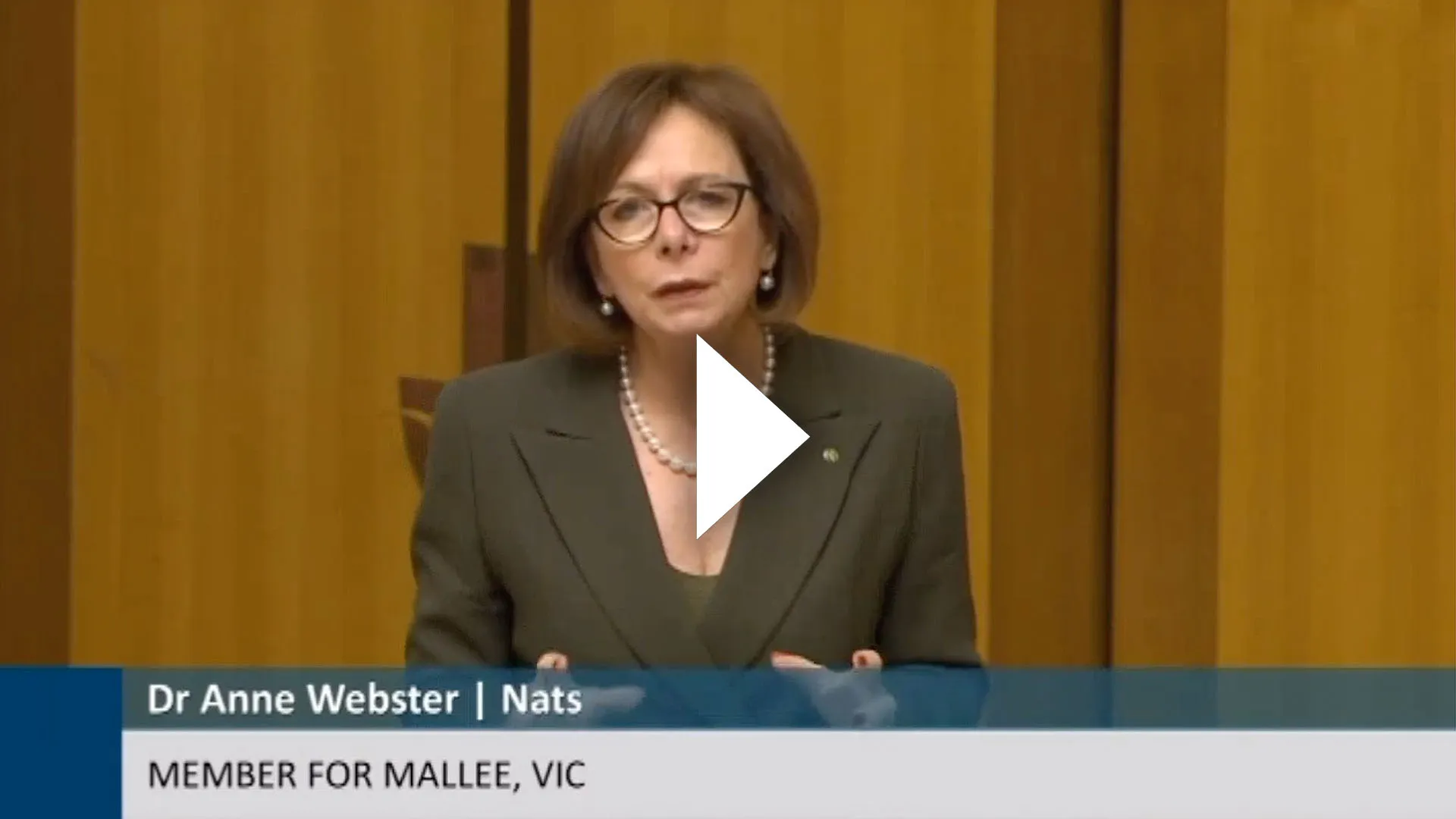
A chorus of Australian farming bodies have howled down the Albanese Labor Government’s claims on the Australia-European Union Free Trade Agreement, as Member for Mallee Dr Anne Webster said the deal hits a sour note with Mallee farmers.
“Farmers in Mallee are appalled by Labor’s deal which contains negative agricultural impacts that Labor walked away from in 2023, but for some bizarre reason have agreed to today,” Dr Webster said.
Mallee farmer Andrew Weidemann said the deal was “exactly what I thought might happen. It’s trading away our right to farm and we, as grain growers, livestock producers will just be taxed more to meet the green economy. This is a joke and when the EU brings in the Annexure IX legislation to stop using edible crops in fuel, no market either! What a mess!”
Mr Weidemann is referring to expected future changes to canola export rules to the EU which would reduce the use of Australian canola in European biofuels. Presently, around 70 per cent of Australian canola is used in European biofuels.
Sheep Producers Australia CEO Bonnie Skinner said Australian sheep producers have been sold out, adding “We are told this is a deal for all Australians, but from the perspective of sheep producers and regional communities contributing to Australia’s food production and exports, it’s hard to see the benefit.”
Australian-EU Red Meat Market Access Taskforce chair Andrew McDonald said “On sheep meat and goat meat, the result is disappointing: 25,000 tonnes (cwt) over seven years, despite Australian industry requesting a minimum of 67,000 tonnes cwt. This stands in stark contrast to New Zealand’s access of 163,769 tonnes, which is an outrageous discrepancy.”
Cattle Australia chair Garry Edwards savaged the deal, describing it as "pathetic with headline trivial volumes not reached for 10 years."
National Farmers Federation President Hamish McIntyre said “A deal with a market of this size offered an opportunity to help ease the pressure on farmers who are grappling with the impacts from the conflict in the Middle East, China’s beef tariffs, and United States trade volatility, which are creating global trade headwinds … They will now pay the price for this subpar EU deal for decades to come.”
Dr Webster said the Albanese Government’s embedding of trade consequences for failing to meet Paris Climate Agreement targets (such as a 43 per cent reduction on 2005-level emissions by 2030) are a serious concern.
“Labor have yet again put political targets ahead of Australian farmers and national productivity,” Dr Webster said.
“Labor’s political plotters have set up a future Coalition Government for trade consequences should the EU deem Australia isn’t genuinely trying to reach 2030 Paris Agreement targets – when, under Labor, we are already falling short.”
Dr Webster acknowledged that, on face value, there were positives for the wine and almond industries from the deal, although farmers would need to keep a close eye on Europe ratcheting up their restrictions on herbicide residues in products.
“The big winners under this deal are critical minerals sector who are, right now, carving up Mallee for mineral sands projects, many with no social licence” Dr Webster said.
“Yet again Mallee farmers and regional Australians are thrown under the bus for the Albanese Labor Government to tick political boxes.”
Pictured: Dr Webster meeting European Commission President Ursula von der Leyen on the floor of the House of Representatives, Canberra, Tuesday 24 March 2026