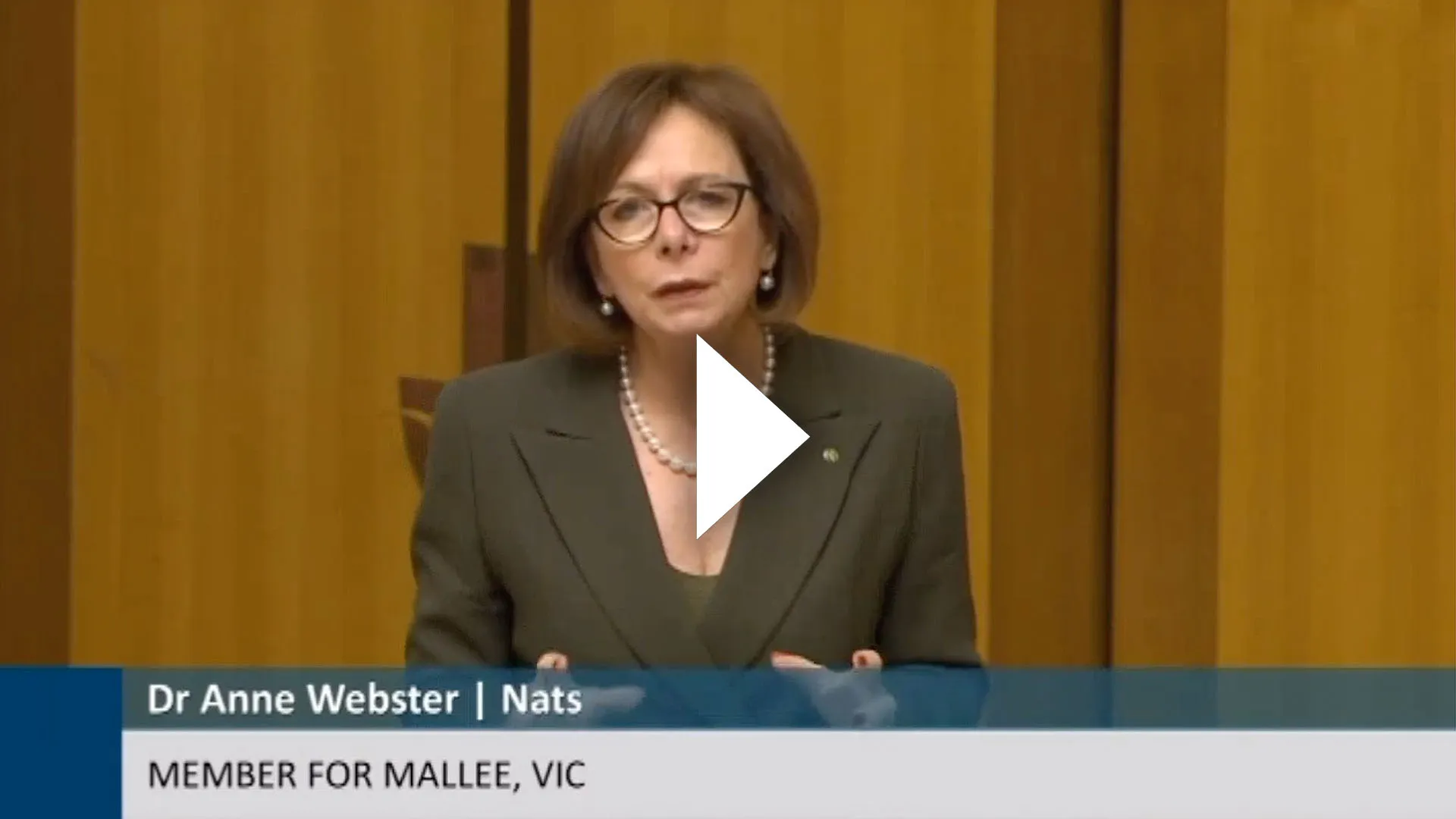

Australia running on empty: fuel security = food security - Media Release

An empty tank equals an empty stomach, Member for Mallee Dr Anne Webster MP said today as farmers warn the Middle East conflict is depriving farms of the fuel needed to feed and clothe the nation.
The Nationals MP also said the Albanese Labor Government was leaving motorists stranded on fuel price gouging.
“Mallee farmers are saying they can’t access what’s known as ‘forward fuel supplies’ – or contracts to secure fuel delivery at a fixed price, or even obtain supply quotes, meaning all they have left is what’s in their machines. Once their on-farm storages run out, that’s it – and then, they can’t produce food or fibre,” Dr Webster said.
One Mallee farmer said fuel “could be the new COVID ‘toilet paper’” if people don’t stop panic buying. He said all shipping deliveries to farmers have been suspended as of Friday 6 March and farmers were on fuel restrictions.
One farmer near Warracknabeal said he is having trouble sourcing 3,000 litres of diesel, and feared local trucking will be in trouble.
Another farmer said fuel companies are not providing him any fuel despite an order being placed on Monday 2 March, and if fuel was not supplied within weeks, sowing would not be able to proceed.
Another farmer heard that metropolitan retail supplies were being prioritised with fuel deliveries to Bendigo ‘running dry’.
“Big oil companies won’t release fuel to independent and small wholesalers because they’re prioritising the city retail market,” Dr Webster said.
The Nationals’ Leader David Littleproud has written to Energy Minister Chris Bowen to get the ACCC to protect both the wholesale and retail markets.
The Treasurer wrote to the ACCC this week demanding action on retail markets, but former ACCC chief Allan Fels said there’s nothing the ACCC can do with their existing powers.
Lawyer Kathryn Edghill told the Courier-Mail that the ACCC are unlikely to find fuel retailers have engaged in misleading or deceptive conduct for opportunistic price rises, if the retailers are not publicly blaming the conflict for the hikes.
“We have just weeks until the farmer fuel supply situation gets desperate, and The Nationals have no faith in the Treasurer nor the Energy Minister to preserve our food and fuel security.”
Farmers used to be able to secure long-term fixed pricing, but now suppliers are moving towards ‘price-adjustment formulas’ linked to global factors, and ‘mid-term price review triggers’.
On 3 March the Victorian Farmers Federation called for urgent federal intervention, saying fuel stock levels and refinery capability needed shoring up.
Dr Webster said Mallee needed investment in biofuel production capacity, as 70 per cent of Australia’s canola goes to Europe for inclusion in their biodiesel capacity. Australia currently imports 90 per cent of its refined fuel use.
The ACCC said on 6 March that the international benchmark price for refined diesel had increased significantly, with the Australian Institute of Petroleum showing in just 8 days a dramatic two-thirds price spike in in diesel (from $130 / barrel on Friday 27 February to almost $220 per barrel Thursday 5 March).
Mallee farmers are also very concerned about urea fertiliser supplies, with one stating he is unable to get his most recent order of 500 tonnes.
A recent Rabobank outlook issued since the bombing of Tehran warned 30 per cent of global urea could be disrupted by the closure or disruption of the strait of Hormuz.
As Shadow Minister for Regional Development, Dr Webster visited the Burrup Peninsula in October to see how Coalition-era federal funding was helping urea and other fertiliser production at sites like Yara Pilbara and the imminent Perdaman CERES project.