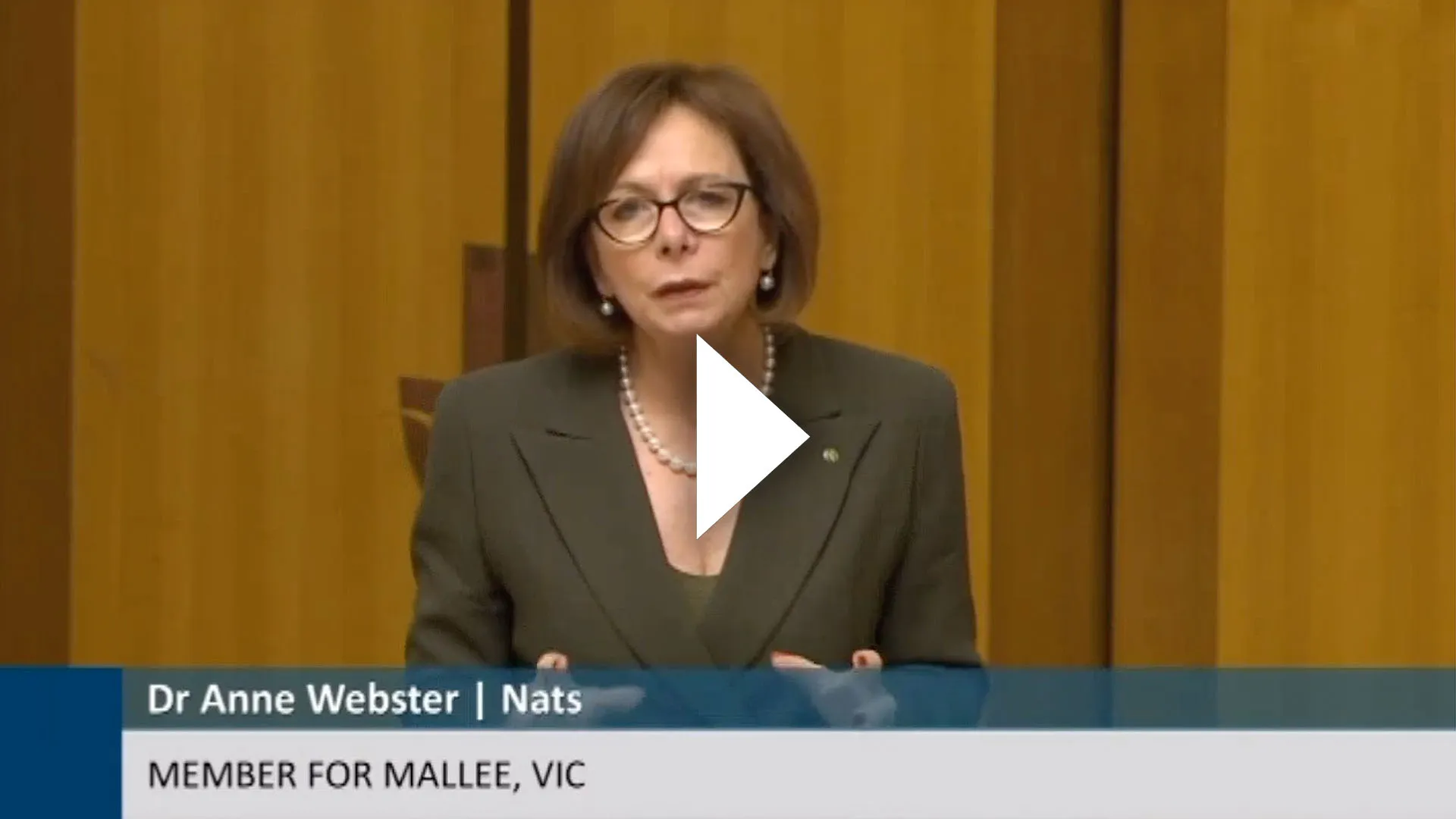

Transcript - Interview with Steven Cenatiempo, 2CC - Wednesday 21 OCtober 2026

DR ANNE WEBSTER MP
SHADOW MINISTER FOR REGIONAL HEALTH
SHADOW MINISTER FOR REGIONAL COMMUNICATIONS
FEDERAL MEMBER FOR MALLEE
TOPICS: Coalition amendments to UOMO legislation, temporary disaster roaming, attack on Member for Indi, mental health, underspending on regional health
Cenatiempo
Something that I've talked about a lot on this program is mobile phone coverage, particularly in regional areas, but even here in the ACT, is pretty pathetic. And if we had to spend all the money we've spent on the NBN on improving our mobile network over the years, well, given that everything works on mobile data these days, we'd probably be better off. But the Coalition has secured 3 amendments to Labor's Universal Outdoor Mobile Obligation legislation, which is aimed at strengthening consumer protections, mobile network reliability and communications during natural disasters. Shadow Communications Minister Senator Sarah Henderson, who we talk to on this program a lot, and Shadow Regional Communications Minister Dr Anne Webster say the changes would legislate temporary disaster roaming, require the Government to establish minimum mobile network performance and reliability standards. Dr Webster joins us on the line. Anne, good morning.
Webster
Good morning Stephen, how are you?
Cenatiempo
Very well. So how is this actually going to work? Because I mean we're kind of at the mercy of private companies here and we're putting conditions on them with regards to their minimum service. What are we likely to see differently after this legislation goes through the Parliament?
Webster
Well, of course the ACCC are doing their inquiry into mandatory domestic roaming at the moment, which was, you know, pushed off the table in 2017 – so, they have picked this up. That's a good thing that they now say, well, maybe that's something we should be looking at. That would be the end point of temporary disaster roaming. For those who don't understand, and if you talk to your audience a lot about this, Stephen, they probably do understand, but a lot of people don't. It means that you can make a call if you're with Telstra, for example, and there's only an Optus tower near you in a disaster situation, you can jump onto that tower and get your call through. Otherwise, you just can't. It's that simple. At the moment, you're talking about the difference between market and government policy. Well, the market at the moment between Telstra, Optus, TPG, they have a non-mandatory obligation in temporary disaster. So, they say they will introduce that voluntarily. There are a lot of things that people say - businesses - and they don't actually deliver. So, it's important the government holds them to account. We think that ultimately the mandatory domestic roaming is the solution to this, but it's on the proviso that we have more towers and Labor have actually pulled that funding from the black spot towers. So, it's got all these gaps. The temporary disaster roaming still as a principle or as a policy is not going to solve that problem because there is no tower.
Cenatiempo
Which was going to lead to my next question, because we've learned over the last couple of years that we are at the mercy of the technology. And if a tower goes down, then an area is without coverage and generally, one tower will be populated by all three carriers. There's never just one that's on a tower. What are we doing to create redundancies for that? And I know satellite technology is developing rapidly, but not rapidly enough to perhaps save us from the next bushfire season.
Webster
Oh, absolutely. Yeah, satellite is, you know, when I first heard about satellite, I thought, yay, finally something that's going to work out in the regions. But no, not so. And they say we'll be able to text maybe if you've got the right handset, blah, blah, blah, by December 27. That's not being able to make a phone call and who knows how long that is going to take. In terms of redundancy to the systems that we have, I know farmers who are still using UHF, CAN radio, you know, whatever system they've used previously, they're still using that because it's more reliable.
Cenatiempo
Yeah, well, and I guess that's the problem is that, you know, technology is great, but when it fails, it fails. I want you to put your regional health hat on for a moment. We saw that horrific attack on Monday that saw Helen Haines, the member for Indi, now fighting for life in hospital. We're led to believe she's lost a leg and may lose another one. Just absolutely tragic. But we're talking about terrorism and all of these kind of things at the moment. But the statement from the alleged offender's family suggests that there might be mental health issues here. Mental health services in places like Wangaratta and where you are in Mildura and the Mallee and even here in Canberra are sorely lacking. This is something we desperately need to look at.
Webster
Mental health, absolutely. But let's not forget drugs and alcohol…
Cenatiempo
… Sure.
Webster
…there's certainly stories about that as well. And, you know, there are also, it's all conjecture at this stage. We don't have clear reports about schizophrenia or some other serious mental health condition. People who have schizophrenia most often don't go ramming people with their cars because they are well managed or those services are in place. So, you're right about that. What I worry about, and mental health is actually not in my portfolio, but I'm happy to speak about it, is that mental health services cannot simply be replacing healthy relationships. I think we too readily go to a government solution or a government-imposed solution on things that are the psychosocial part of medicine, which there is a great deal. It is about having a healthier society more generally, which kind of goes also to what the terrorism aspects of this particular incident are.
Cenatiempo
Yeah, and I understand that and I'm not discounting that at all because this government has done far too little to actually speak out against domestic terrorism and the causes behind it. They choose a political solution rather than one that's protective of the community. But I think this is an opportunity to have that conversation about services in regional areas, just in more general terms.
Webster
Yeah, well, we know thanks to the National Rural Health Alliance that there is a $9.3 billion underspend in the regions in health. $9.3 billion. I mean, for goodness sake, that equates to, depending on where you are, whether you're in a Modified Monash model 3 area or 6 area or 5 area, it depends, it's greater in those higher numbers. In other words, where there are less people, there are less services, clearly. The underspend is greater. But the fact is, this is an ongoing increasing trend where the government is not spending on health services, whether that's through state government public health systems or whether it's through private investment, as in government investing in training in the regions, including in mental health. All of these things, you just can't put it aside from the fact that the money's not being spent there. It's easy for the government to spend on big, flash, incredible hospitals, and they are incredible, in Melbourne and Campbelltown in Sydney rather than ensuring that healthcare is equitable. And it clearly is not.
Cenatiempo
Certainly, a lot of work to do. Anne, really appreciate your time this morning.
Webster
No worries at all. Thanks, Stephen.
Cenatiempo
Dr Anne Webster, Shadow Minister for Regional Health and Regional Communications.