
News Journalism Payments Bill
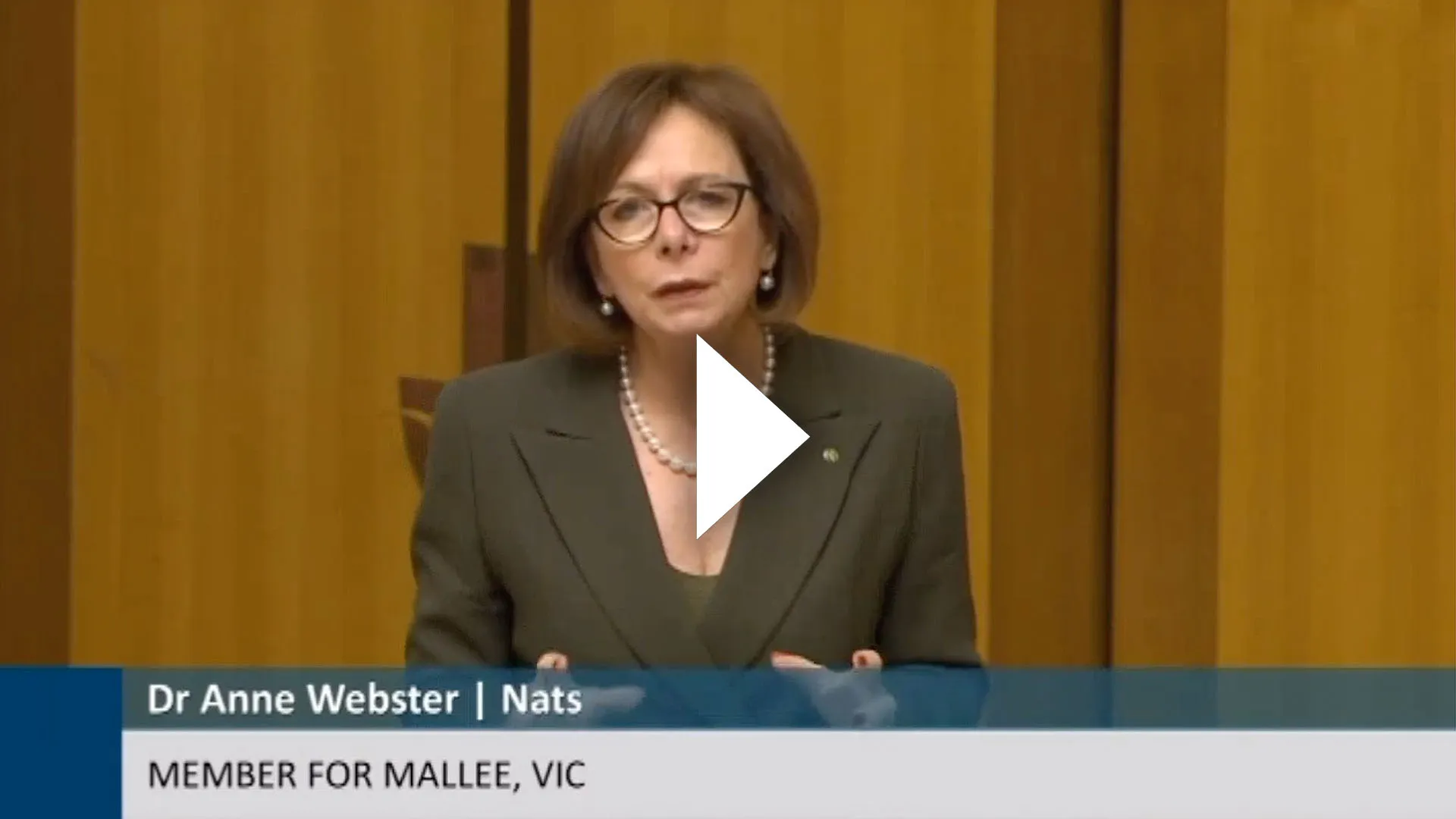
Dr WEBSTER (Mallee) (18:44): At its heart, this debate is not about tax settings, offsets or administrative frameworks; it's about whether Australia continues to have a diverse, independent and sustainable media landscape. A healthy democracy requires informed citizens, vigorous public debate and journalists who are willing to ask difficult questions. It requires a plurality of voices, not a concentration of information in the hands of a few powerful global actors. It requires local journalism, regional journalism and community journalism. It requires people who know their communities and tell their stories. That is why the coalition has always recognised the importance of supporting Australian journalism and defending media diversity.
The House should remember how we arrived here. The news media bargaining code was not created by the Labor government. It was a coalition reform, starting in 2019, when we in government tasked the ACCC with addressing the imbalance between global digital platforms and Australian news publishers. The resulting voluntary negotiations failed, so the coalition stepped in with the world-leading news media bargaining code 2021. The code addressed the bargaining imbalance between major digital platforms and Australian news organisations. It delivered more than 30 commercial agreements, worth an estimated $250 million annually, to Australian news businesses. It demonstrated that governments do not have to accept a situation where Australian journalism carries the cost of producing news while multinational big tech companies capture much of the value. The coalition acted, we showed leadership and we delivered results.
Meta's decision not to renew agreements in 2024 clearly exposed weaknesses in the framework and created uncertainty for publishers. Labor were not prepared for the fight in government. They didn't enforce the code and dismantled the framework instead. What followed were two years of drift from the Albanese government. The government announced its intention to replace the code in December 2024, yet the legislation was not introduced until this month, August 2026. That's two years of uncertainty for news organisations, two years during which publishers had no clarity about future arrangements and two years in which regional and independent publishers had every reason to worry about their long-term sustainability. If local journalism matters, governments should act with urgency. Instead, Labor spent two years developing a replacement for a coalition framework that was already delivering outcomes.
The Nationals will not oppose this legislation, the News Journalism Payments Bill 2026 and cognate bills, in the House. We recognise the importance of securing ongoing support for Australian journalism. We recognise the need for a mechanism that encourages commercial agreements between digital platforms and Australian news journalism. We recognise that Australia's media sector continues to face significant economic pressures. Most importantly, we recognise that regional journalism cannot be left behind. But our lack of opposition does not mean a blank cheque. It does not mean pretending the legislation is perfect. It does not mean ignoring legitimate concerns about its operation. It means taking a constructive approach while continuing to fight for improvements.
As the shadow minister for regional communications and as a resident of regional Australia, I know, and my Nationals colleagues know, that journalism is not merely another industry. It is civic infrastructure. Local journalists cover councils, courts, schools, hospitals, water policy, agriculture, sporting clubs and community events. They are also the first on the scene at natural disasters and major accidents and often know a lot more about what is happening on the ground than metropolitan or national media. Local newspapers, television stations and radio stations hold local institutions accountable. Local media celebrates local achievements. Local media strengthens community identity. Local media builds social cohesion. No metropolitan newsroom can properly replace local journalists embedded within their communities. Local media employs local people. It also remembers local history. Outside media might swan in for a flood or a bushfire, but then they go. Local media are there helping, holding governments to account for the delivery of recovery services after the spotlight is gone. Once a regional newsroom closes, the damage is huge and difficult to reverse.
As I've said before, those who live in Sunraysia feel invisible to ourselves with no local television presence. WIN Television has established a service, and credit to them, but it's not yet got local journalists on the ground. That's the awful bind regional media outlets face—declining advertising revenues, a commitment to local news and fierce competition with offshore social media companies. Once local stories stop being told, a community's identity falls away.
That is why provisions recognising regional journalists and smaller publishers are welcome in this bill. The increased weighting for regional journalists reflects an important truth: a diverse media landscape requires strong regional media. I flagged that we in the Nationals will be closely watching the outcomes of this scheme and its loading for small and medium publishers. While the formulas in the bill preference small to medium publishers, which publishers are they? What we cannot allow is metropolitan based publishers in already relatively saturated media markets to grow from this incentive as regional media fails.
National stories inform us about Australia, but local stories connect us to our communities. They tell us who we are. They document our triumphs and our challenges. They preserve local history and local culture. They create belonging. This is particularly important in regional Australia, where local media often serves as the central thread connecting communities spread across vast distances. A democracy is stronger when local voices are heard. A democracy is stronger when communities can see themselves reflected in the media they consume.
Media diversity is not simply about having more publishers; it's about preserving different perspectives, different experiences and different voices. Australia is like a diamond with many facets. The CBDs of Sydney or Melbourne or Brisbane look very different to life in regional Australia. It is one reason we, the Nationals, exist—to show the real face of regional Australia, to be the voice of regional Australia to the rest of the nation. If Australians are glued to their phones, doomscrolling three-second videos from overseas, and if local stories are not told, we risk merging into some singular global zeitgeist. Local stories from regional Australia matter to our national identity. That's why the coalition's work on the news media bargaining code mattered so much to us in 2021 and why it is so important that we patch up the damage from Labor's two years of delay in ensuring the code delivers for all Australians.
The coalition believes the government had settled on a 2.5 per cent charge rate on a digital platform's advertising revenue, which was too low. We have argued the levy should increase to 2.75 per cent. If this scheme is intended to incentivise commercial agreements then the incentive must be meaningful. The coalition does not believe big tech should be rewarded with a softer arrangement after delaying negotiation for years. We cannot reward Meta's behaviour, their stalling, which has saved them many millions of dollars with a rate that doesn't reflect the real impact of that delay. I note that the government estimates that this scheme will see about $200 million to $250 million in deals. That's less than what the coalition's code was achieving five years ago. We want stronger incentives for platforms to come to the table and support Australian journalism. The success of the scheme depends on one crucial question: how much Australian digital advertising revenue are these companies actually earning? If revenue is understated, liability is reduced. If liability is reduced, support for journalism falls. It's that simple.
The coalition has therefore proposed stronger powers for the ATO to obtain information and estimate revenue where platforms fail to cooperate. We cannot have a system that relies on multinational corporations marking their own homework. Publishers need certainty. Newsrooms need certainty. Journalists need certainty. Local regional media outlets need certainty to pay the bills, including for staff, and to have revenue certainty. Only then can they invest and expand. The coalition has proposed requiring commercial agreements to be concluded before the start of each calendar year. News organisations should not spend months wondering whether funding arrangements will continue. Certainty encourages investment. Certainty supports employment. Certainty helps keep journalists in newsrooms.
This debate also arrives at a remarkable moment in digital and technological history. Artificial intelligence is reshaping the way information is created, distributed and consumed. Increasingly, people receive summaries rather than reports, answers rather than investigation and conclusions rather than analysis. I mention AI because this incentive program will need to be agile to respond to the current reality that AI is accessing news stories behind paywalls already, and therefore news publishers are not getting revenue from their articles. With AI poised to supersede searching or googling for information in the very near future, we cannot let this incentive scheme become redundant as soon as the ink dries on the legislation.
The more sophisticated technology becomes, the more vitally important critical thinking becomes. We cannot let Australians today accept that the media platform answer must be correct. The error rate will feed into our institutions and way of life, potentially with fatal consequences. We must ensure that journalism continues so that critical thinking survives. We must keep exercising the collective Australian brain or it will atrophy, and we will be pulled in the directions that AI—or foreign actors behind it—send us to achieve their priorities or purposes.
Young Australians need to learn how to analyse evidence, how to compare competing claims, how to identify assumptions and how to develop their own conclusions. They need to learn how to think, not what to think. Strong journalism and strong critical thinking go hand in hand. One provides information; the other enables citizens to evaluate it. Together they form part of the foundation of a strong democracy.
The coalition will not oppose these bills, but neither will we ignore their shortcomings. We are proud of the coalition's record in creating the original bargaining framework. We are disappointed that Labor took more than two years to replace it. We are determined to improve this legislation through practical amendments. Most importantly, we remain committed to preserving what really matters: a diverse media landscape, sustainable journalism, strong regional news services, thriving local voices and Australians equipped to think critically and engage actively in democratic life. Democracy depends on more than institutions. It depends on informed communities, it depends on local voices, and it depends on ensuring that Australian journalism continues to have a future.