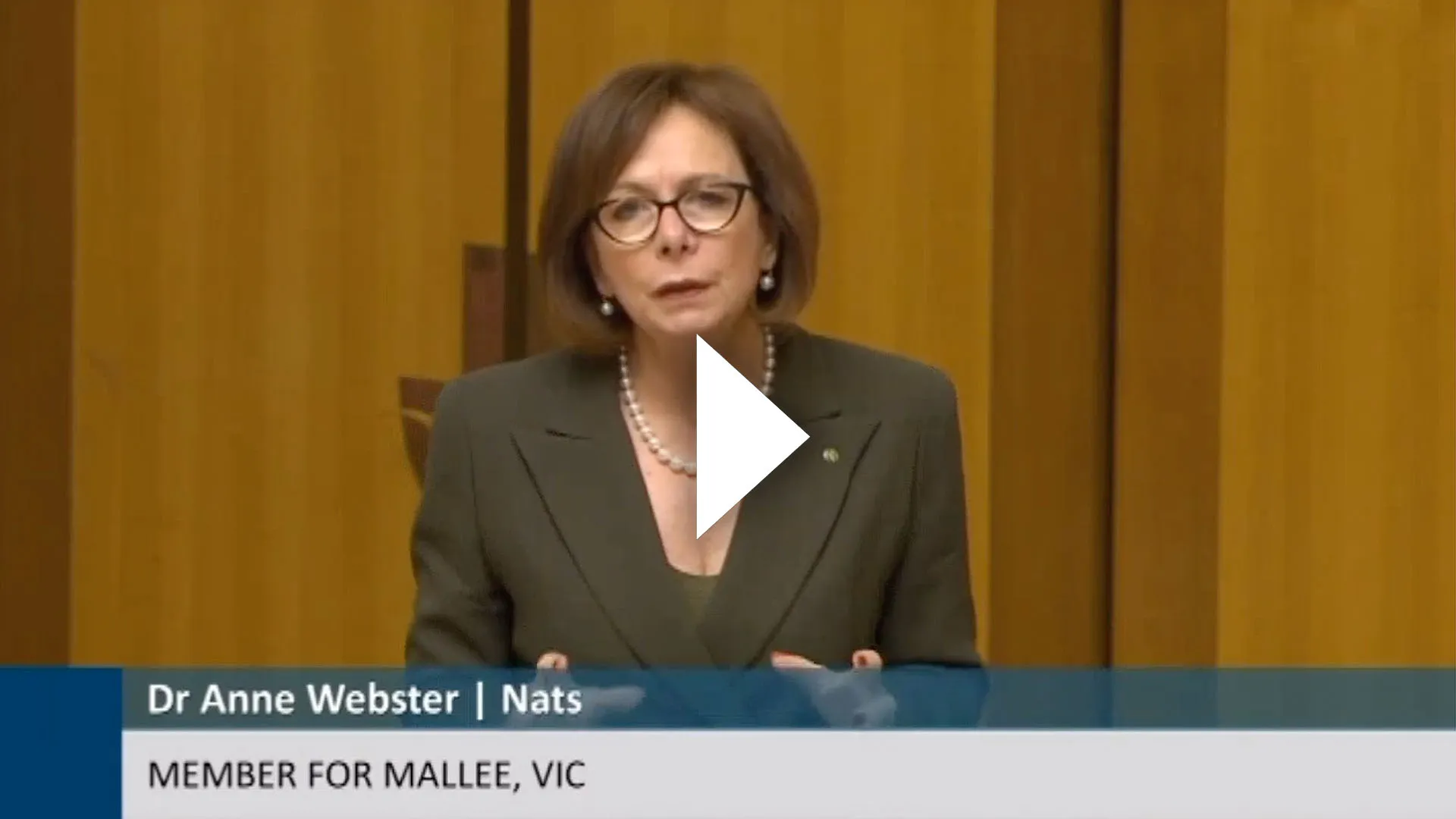

Interview with Tom Connell, News24 'Politics Now' - Wednesday 30 September 2026
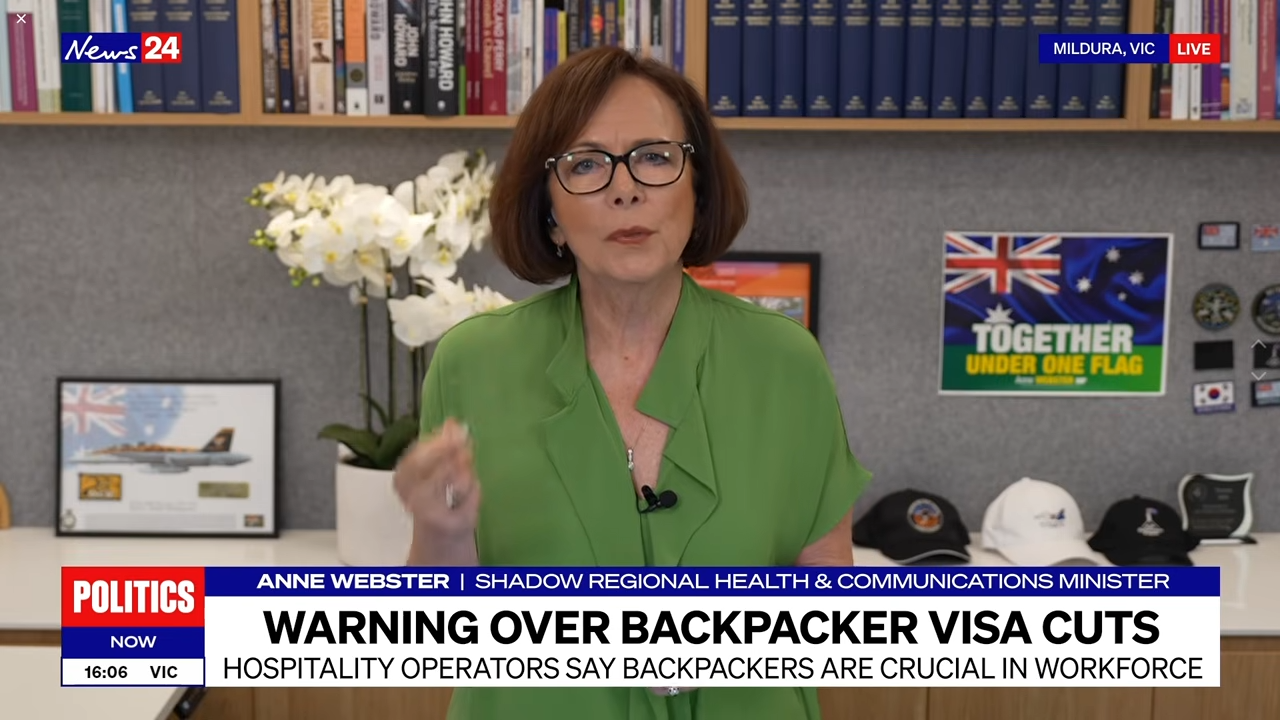
DR ANNE WEBSTER MP
SHADOW MINISTER FOR REGIONAL HEALTH
SHADOW MINISTER FOR REGIONAL COMMUNICATIONS
FEDERAL MEMBER FOR MALLEE
TOPICS: working holiday maker scheme, conflicting Labor MP positions, impact of Australia-UK Free Trade Agreement, interest rates, productivity
Connell
The Nationals are sounding the alarm over changes to the working holiday makers scheme, leader Matt Canavan was on the Gold Coast today. He's reiterating warnings that changes will disadvantage the agriculture and hospitality sectors.
Canavan
If it ain't broke, don't fix it. The backpacker visa system is not broke. It works very well for our country. Provides workers who want to work. It's in the title, working holiday makers. They want to work. They come here and fill jobs that are often hard for Australians to do if they're seasonal or out in the middle of nowhere on a farm, and they fill those gaps that we need in our economy.
Connell
Joining me live now, Shadow Minister for Regional Health and Communications, Anne Webster. Thank you for your time. So, the changes from Labor don't necessarily mean fewer regional workers. It all depends how this ballot system works. Why are The Nationals so convinced it will be a failure?
Webster
Well, we know that the numbers will be severely reduced. So, if you take the simple case of the third year going from 31,000 to 5,000 last year, we had 42,000 working holidaymakers who were working in horticulture. They were working in broad acre farming. They were working in tourism sectors. And as Matt in your clip said, these are sectors that people in Australia don't want to work in. It works incredibly well. Why would you want to fiddle with that? And I think we we know the answer. This is political. It was always political. It's why Tony Burke put off his National Press Club address so that he could deal with the fractures in his own party. And today we find that there are Labor MPs, state and federal, who either don't agree with one another for sure. Some who support, some who absolutely don't support this change.
Connell
Okay, but the actual change, so that second year where people, if they want the third year, need to do six months of work in the regions, you can still do it in higher numbers. It's just the ballot system only ends up with 5,000 visas. So, it all depends how many people want to chance their arm, doesn't it? It's not going to go down to 5,000. That's not the actual policy.
Webster
Well, the ballot system will certainly take it down to 5,000. That's the point. They want to limit it to that without good evidence. That's a third year. It is political.
Connell
They don't have to do any work in the regions. Yeah, I'm just trying to clarify what the policy is for our viewers. So, theoretically, you could get the same number of people doing the six months in the second year, but only 5,000 of them get the third year where they don't have to do any regional work.
Webster
Well, it's also there is a reduction in that second year, but I'm actually really keen to talk about what's happening right now, which is that Tony Burke has put the go-slow on working holiday makers this year, and in fact they've gone this unbelievably weird workaround to go with the National Farmers Federation and the Victorian Farmers Federation - and any other peak body - who would like to put in a list of names of people who have been waiting a month and a half at least already for what should take a day, according to the department's own website, to have their approvals. They're coming from UK, Ireland, Canada to do jobs that Australians largely do not want to do, or are not skilled to do, and particularly I'm concerned about broadacre farmers because they are represented in my electorate, and you know a vast swathe of New South Wales and Queensland in it too, and they have not been able to get those visas approved until now. Now Tony Burke has given the National Farmers Federation, the VFF, and other peak bodies somehow this pseudo-role in approving visas to suggest to the Department of Immigration – Why?
Connell
When the line came from that Canavan of "It ain't broke, don't fix it, is there one part of it that is broken? This free trade deal with the UK means none of their backpackers have to do any regional work to get three years. Is that something that might need to be renegotiated?
Webster
Look, I think that now that it has been broken - thank you, Labor - then I think that all discussions will take place.
Connell
… This was a deal in the Coalition. …
Webster
… The free trade agreement was under us. That's right, exactly. It was, and it gives, as I think we've discussed before, it gives Australians the same rights in the UK. That doesn't account for all of the others, and a lot of the UK guys still come out into the regions to do that work that nobody else wants to do. It's incredibly important that those visas are approved. I found out from farmers today that some have been approved this week, thanks to lobbying. And I'm now lobbying with Julie Collins as well, Minister for Agriculture, to seek her assistance for those who are not members of the NFF or the VFF, this can't become a membership drive for peak bodies to fulfil a job that the Department of Immigration under Tony Burke should be doing in the first place. It absolutely doesn't make any sense. Any which way you dice it or slice it, it doesn't make sense, and it is risking productivity. I mean, we heard the RBA chief yesterday talking about productivity. This is a key component.
Connell
Let me ask about the rate rise and inflation. We have heard from the RBA around domestic issues, but also clearly a significant factor: the war in the Middle East. So, is it important to acknowledge multiple factors here?
Webster
Look, I think Jim Chalmers - was it eight or ten times? - in his brief discussion mentioned the war in the Middle East. I don't believe that Michelle Bullock used the same number to talk about the war in the Middle East. Of course, it is playing a part. But if we look at our OECD comparable countries, our interest rates and our inflation rate are nowhere near theirs. They are doing quite well, and we are not. Our inflation is going up, continues to go up, and our interest rates continue therefore to rise. So, it is a problem for Australia, and it's one that absolutely hinges on productivity, which is what Michelle Bullock said. The government is good talking about the word; they can use the word, they just can't do it. They can't actually govern to see Australia thrive again, and that is the key factor.
Connell
Headline inflation across the OECD was 4.1 per cent in the last measurement in July. That's higher than us.
Webster
Yeah, but now Australia is absolutely leading the way, and we've had 15 interest rates under the Labor government …. Pardon?
Connell
… But you just singled out the OECD. The rate of inflation in the OECD is higher than Australia's at the moment.
Webster
The headline, but the Australia's interest rates are continuing to rise. And Michelle Bullock has made it really clear that there is an expectation - others around her - that there could be two more rises before we come to Christmas. That is not Happy Christmas Australia, and we need a better outcome than what we've got right now.
Connell
Two more. You say there could be two more before Christmas?
Webster
That's what I'm reading. I'm sure you're reading that as well, Tom.
Connell
I haven't heard two more. I'll be battening down the hatches – well, I already am, as it is. We better leave it there. Anne Webster, thanks for your time.
Webster
Thanks.