
Interview with Gary Hardgrave, 4BC Mornings, - Thursday 15 October 2026

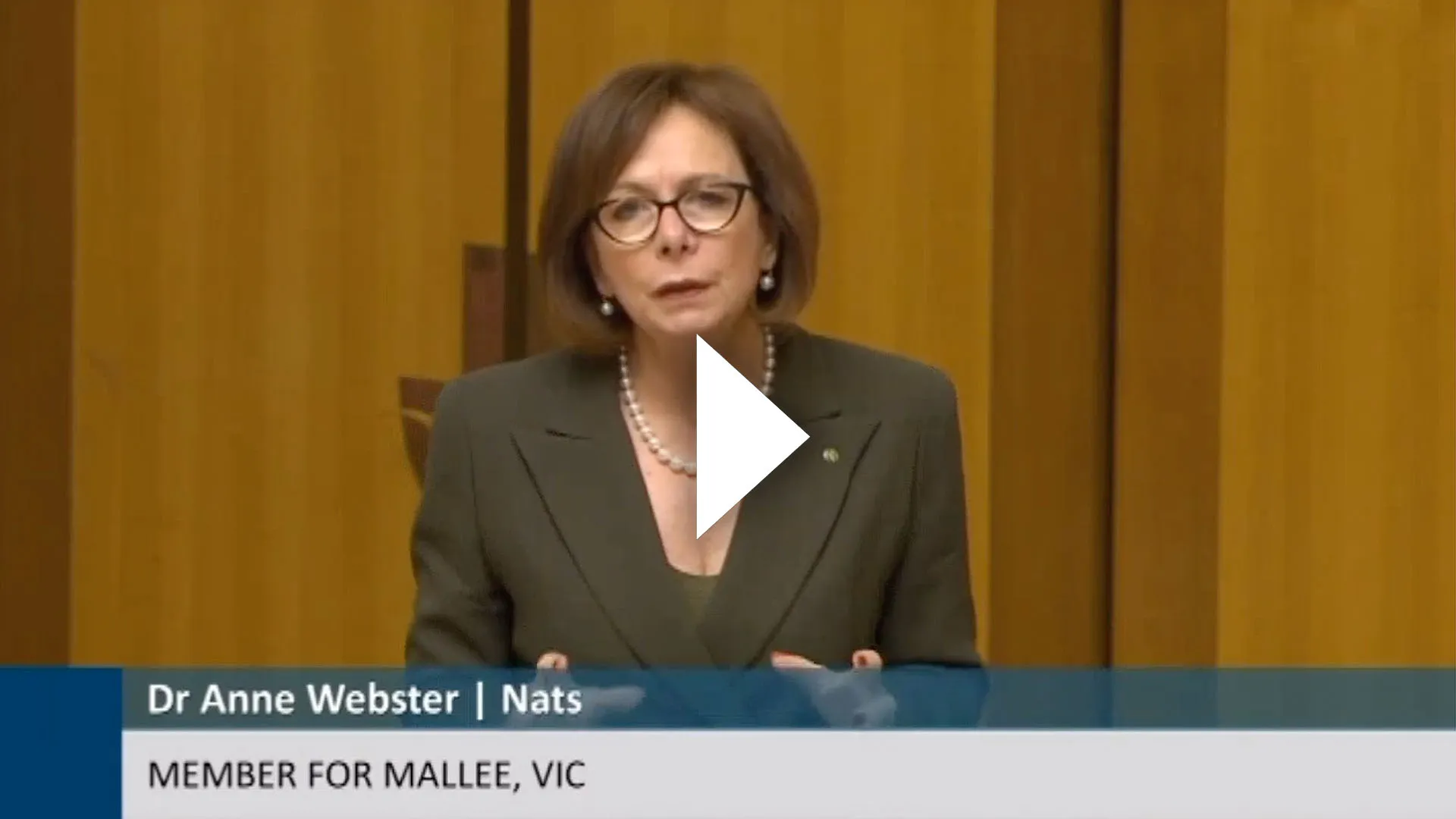
Shadow Minister for Regional Health, Shadow Minister for Regional Communications - Member for Mallee - Transcript - Interview with Gary Hardgrave 4BC Mornings Brisbane - Thursday 15 October 2026
DR ANNE WEBSTER MP
SHADOW MINISTER FOR REGIONAL HEALTH
SHADOW MINISTER FOR REGIONAL COMMUNICATIONS
FEDERAL MEMBER FOR MALLEE
TOPICS: government underspending on regional healthcare, National Rural Health Alliance, regional mortality rates, flight reliability, private health insurance rebate, tax treatment of premiums, aged care funding
Hardgrave
We get to talk to the Shadow Minister for Rural Health, Dr Ann Webster now. Good to talk to you again, Anne. Thanks for your time.
Webster
How are you, Gary?
Hardgrave
Look, I'm all right. You're in a rural part of Victoria, way over in Mildura. You understand exactly what I'm saying here. Country Australians, regional Australians are getting short shrift from this government.
Webster
Absolutely, 100 per cent they are, and when you find out that rural people - this is about people, we always need to remember that - who live in rural towns, receive 50 per cent less investment than metropolitan people – so, people in the cities, have around $12,000 invested in their personal health each year and in rural country towns, $6,000 is spent. I mean, that is outrageous, right there, because it talks about a value proposition that if you live in the city, well, your life is more valuable than if you live out in a regional town. It's honestly disgraceful and I've got to praise the National Rural Health Alliance for the work that they've done, the research that they've developed, with new research and the stories that they've come up with now, the facts, which are that there are more men, around 100 more males die in outer regions than males in the city. And we have 476 women who die each year out in the country compared to 411. So, the figures are awful. We've always known that mortality and morbidity rates, sickness and death out in the regions is more prolific, sadly, than it is in the city. So, you would think, Gary, that that would inspire the government to come up with policy that changes that. They're always talking about equity and they're always talking about fairness I can tell you right now, this is not fair and it is not equitable.
Hardgrave
Well, it's certainly not but Anne Webster, it could also be a statistical reality. Let's face it, all the big expensive bureaucracies for health are all in the big cities. So maybe what we need to do is to move a couple of those out into country areas and on paper the numbers might look better or is it not that simple? Is it just simply reality? The facilities aren't there, the support is not there for a lot of other reasons.
Webster
Absolutely. It is about investment in facilities. It's about investment in workforce. It's about reaching that point where people are willing to come out as in professionals, health professionals are prepared to come out to the regions because there is enough support around them. At the moment, that investment is not being made by the government and we're calling them out every day about this really inequitable behaviour. So, it's not just about bureaucracy, it is certainly about the actual outcomes and our mortality and morbidity rates totally reflect that.
Hardgrave
Yeah, no, fair enough. It just seemed to me instinctively I should ask that question on the record. I know that, for instance, in the mental health space, that clinical psychiatrists are so scarce in regional Australia, west of Toowoomba, north of Adelaide and Canberra, south of Darwin and east of Perth, there's like one. I mean, one in productive areas. You know that that, in itself, proves very much so the case that we're not getting the specialist care where we need it and I get it people visit and people fly in fly out but it's still left to chance it's still left to the ability of somebody in a rural community to actually... motivate themselves to get on a plane or hope that some medical specialist comes towards them. This is just not good enough in this country.
Webster
No, no, it's absolutely not good enough. And in my town, Mildura, as you said earlier, we have fly in, fly out specialists who are at the whims and mercy of Qantas and actually taking off. And unfortunately, we have one of the highest cancellation data from Melbourne to Mildura, which is not a good story because if a specialist can't get to Mildura, the whole surgical list just goes out the window. Everybody has to be repositioned at another date whenever that couldn't be fitted in. Likewise, people in Mildura have six hours to get to specialists in Melbourne, six hours on really poor roads. So, the inequity is actually more broad than simply the numbers that we're talking about here.
Hardgrave
Well, Mildura is like an outer suburb compared to Longreach compared to other places in Queensland, but I take your point. Can I ask about this whole nonsense? Why would this government even consider dropping the private health rebate for above 65? I personally think everybody should be able to claim private health insurance as a legitimate tax deduction each year - everybody then doesn't need a rebate, doesn't need a grant and a gift from government taxpayers - it actually just, you know, if you're getting paid a wage you pay tax - add the private health on top of that if you're on a pension the private health insurance is just is part of what you should be able to expect yet the government was targeting above the age of 65, that seemed unbelievable to me.
Webster
Well, it is just at cross purposes of what they say. They say that somebody who is 30 should be paying the same private health insurance as someone who is 65. News flash to Mark Butler and to Jim Chalmers – the people who have been paying private health have often been paying it for decades, squirrelling that away as you said earlier, and putting it into private health, because after you’re 65 that’s when you need those knee replacements, cataracts and whatever else might go wrong after 65. People have been doing that. When they reach 65 there are 1.2 million pensioners out of 3 million over 65 people who are on private health. Mark Butler has gone into the House this morning, he’s not going to die on this, he is going to keep pushing it, the Greens have said in the Senate they would support the bill to cut the rebates if the pensioners are cut out. News flash to the Greens – self funded retirees are often not on very much. They’re managing their money after 65. They are often on not a lot more than a pension anyway. Its stupidity on steroids and its stuff like this that does my head in in the House …
Hardgrave
It does my head in - Anne Webster I just thikn we should get people in this early. Fully waged people should be able to claim it as a tax deduction. The way mutuals work, as you know, you’re an intelligent person, I like I think I can be some days, for a male I’m not too bad – if you get more people into the pool, the overall cost of that pool is reduced, so private health insurance costs could go down if we simply made it a tax deduction for fully waged people. I don’t expect you to do policy on the run you’ll have to need to talk to my old mate Anne Ruston the Shadow Health Minister and your colleague – in the end we need more people taking up private health insurance not having people dropping it
Webster
Absolutely, because what will be a result of this is you will have over 65 people in the public health system. We already know that older people over 65 generally are ending up in ED, are ending up in beds in hospitals, there aren’t enough beds in those EDs or hospitals, so it’s just not a great outcome. Whereas if they have the support, in private health, they can get the surgeries that they need and they can continue motoring on at home with a proper Support at Home care package. What this government wants to do is flog $3 billion from savings in the private health insurance space and theoretically put it into 5,000 new beds in residential aged care. Again news flash to Mark Butler, people don’t want to go into residential aged care. They actually want to age at home. I’ve done forums and roundtables and that is what people are saying and people cannot get these packages, because the government is so slow to action and to put the money where it needs to be.
Hardgrave
This is just heartless this government, everywhere you turn, everyone’s angry about it, Anne you just go well, its good to talk to you, you - to me - sound like you’ve got your act together, you’re welcome on the program any time. Nice to talk to you again
Webster
Thank you
Hardgrave
Anne Webster there, she’s the federal member for Mallee, she’s Shadow Minister for Rural Health - what a hell of a job. It’s important that postcodes should not dictate the healthcare you get. But for people in productive areas that’s exactly what goes on. Crazy stuff.