
Common sense prevails on farmer herbicide use - Media Release

Tuesday 23 June 2026
The Member for Mallee, Dr Anne Webster MP, has welcomed today’s decision by the Australian Pesticides and Veterinary Medicines Authority (APVMA) to retain farmers’ access to paraquat and diquat under revised scientific conditions.
Dr Webster said the decision reflected what farmers across the Mallee and regional Australia have - at great effort - consistently argued: that practical farming realities, evidence and modern application practices must guide policy.
“The continued, restricted use of paraquat and diquat is a win for common sense,” Dr Webster said.
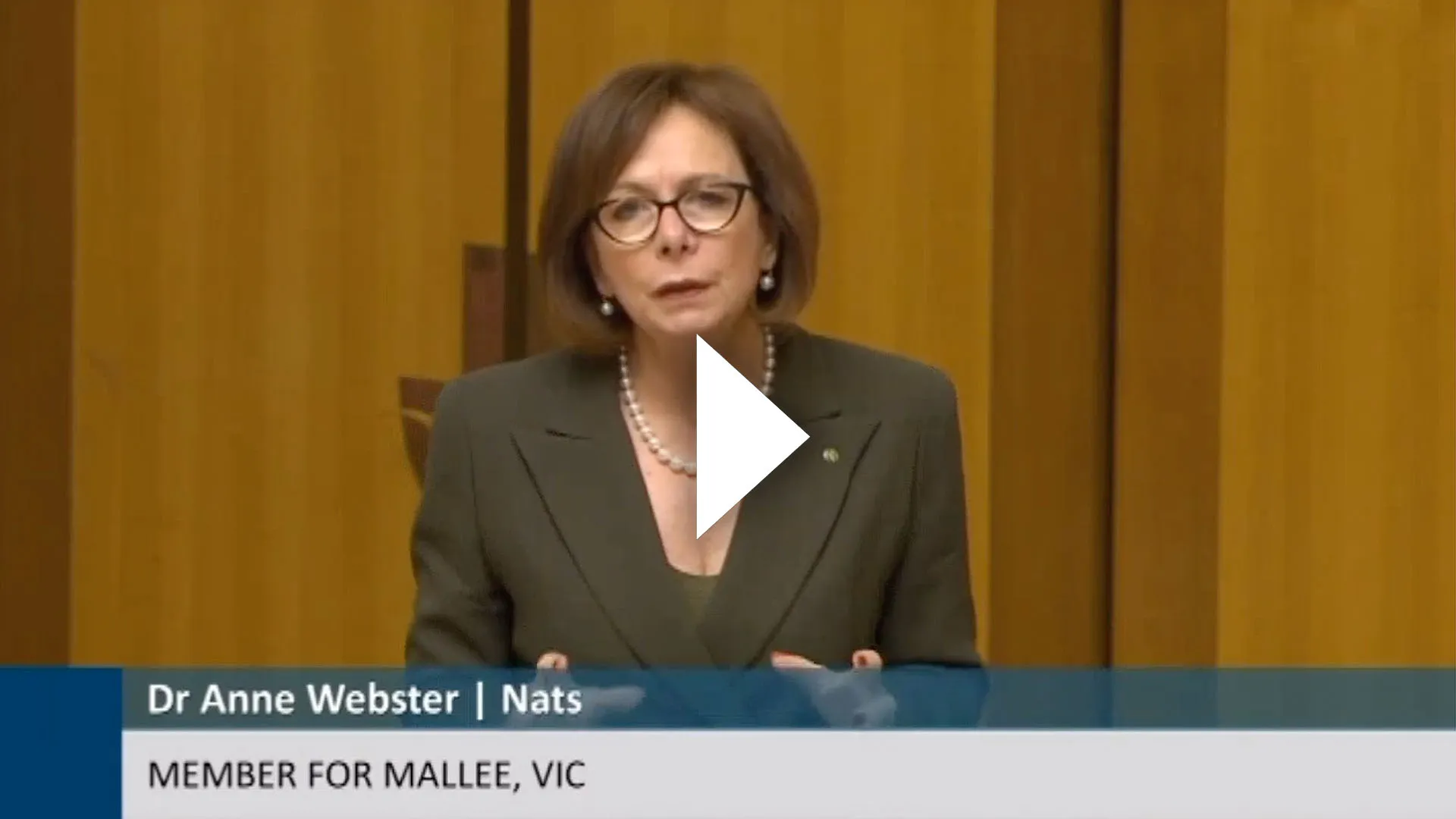
Dr Webster moved a motion in the House of Representatives in November that the Albanese Labor Government respect farmers and the science, and not give way to sensationalism.
“As I have said previously, policymakers must ‘listen to the voices of farmers who responsibly rely upon paraquat and diquat to control weeds, avoid heavy‑tillage farming and retain soil and moisture in their cropping lands’ and ‘listen to the science’.” Dr Webster said.
Today’s APVMA determination confirms that paraquat and diquat will remain available for use, subject to stricter controls aimed at reducing exposure risks.
Importantly, the regulator concluded that “the weight of evidence does not show that paraquat exposure through approved uses increases the risk of developing Parkinson’s disease.”
Dr Webster said the APVMA’s decision underscores the importance of Commonwealth bodies listening to those with lived experience in the field.
“At every step of this process, I have urged the regulator and government to respect farmers’ experience and perspectives, not emotion or conjecture.”
In her previous parliamentary contributions, Dr Webster has emphasised both caution and compassion in the debate, for instance saying “I fully empathise with those that suffer neurological conditions… this motion is about the practice and science today, not what might once have been.”
Dr Webster said it was important to acknowledge community concerns while also recognising the significant differences between historic practices and modern regulated use.
“Modern application methods are tightly controlled, targeted, and designed to minimise exposure. That distinction matters,” Dr Webster said.
Dr Webster also reiterated warnings about what would occur if farmers were denied access to effective weed control tools.
“Farmers now apply herbicides in protected environments that are safe, with virtually no exposure to the chemicals,” Dr Webster said.
“And as I have raised before, reducing these tools to ineffective levels risks forcing a return to heavy tillage farming — with consequences for soil health, erosion, and dust storms that affect entire communities.”
INDUSTRY WELCOMES OUTCOME
Today’s decision has been welcomed broadly across the agricultural sector.
Grain Producers Australia Research, Development and Extension spokesperson Andrew Weidemann said the role of paraquat and diquat in sustainable farming systems remains critical.
“These farming systems have driven significant productivity gains over recent decades while reducing soil erosion, improving moisture retention, lowering fuel use and supporting more sustainable grain production,” Mr Weidemann said, warning that removing or excessively restricting them would undermine productivity and sustainability.
A BALANCED WAY FORWARD
The APVMA decision introduces additional safeguards, including reduced application rates and strengthened handling requirements.
Dr Webster said Australian farmers want to do the right thing — for their families, their workers, their communities and the environment.
“Farmers and their communities deserve a regulatory system that respects both the science and the importance of keeping Australian agriculture productive, sustainable and globally competitive,” Dr Webster said.